








 Contact Platform Support
 Help Center
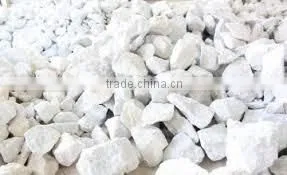
GCC 98,5% CaCO3, Whiteness 97%, From Vietnam, Uses for Paper Making, Impurity ->0


Related Products
-
 Upsale to 15% Ground Calcium Carbonate 98.5% CaCO3, Material From Vietnam, High Quality but Response Price for RubberUS$ 72 - 75MOQ: 20 Tons
 -
Calcium Carbonate Powder From Vietnam, Made From Limestone 99% CaCO3 for Paint, Plastics, Rubber, Paper MakingUS$ 84 - 100MOQ: 20 Tons
-
CaCO3 Powder From Vietnam, Made From Limestone 99% CaCO3 for Paint, Plastics, Rubber, Paper Making//s/US$ 84 - 100MOQ: 20 Tons
-
Super Fine CaCO3 Powder, Limestone 99% CaCO3 for Paint, Plastics, Rubber, Paper Making//s/US$ 84 - 100MOQ: 20 Tons
-
Uncoated Calcium Carbonate - CaCO3 98% Cheap Price From Vietnam, Use for Paper, Pain, Plastics, RubberUS$ 120 - 130MOQ: 20 Tons
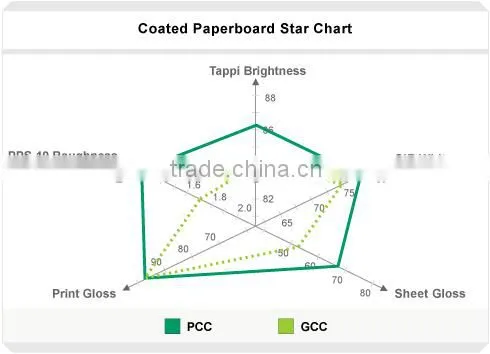
Paper, Plastics, Paints, and Coatings: Calcium carbonate is the most widely used mineral in the paper, plastics, paints and coatings industries both as a filler – and due to its special white color - as a coating pigment. In the paper industry it is valued worldwide for its high brightness and light scattering characteristics, and is used as an inexpensive filler to make bright opaque paper. Filler is used at the wet-end of paper making machines, and calcium carbonate filler allows for the paper to be bright and smooth. As an extender, calcium carbonate can represent as much as 30% by weight in paints. Calcium carbonate also is used widely as a filler in adhesives, and sealants.
Permanence of Alkaline Papers Acidic paper is the villain. Alkaline paper is the good guy in the white calcium carbonate hat. That is essentially the way The New York Times contrasted their permanence. It has long been recognized that the papermaker's alum contributes sulfate ions to the process in addition to the desired aluminum ions. In the aqueous system, the sulfate and aluminum ions are free to react with available protons to produce weak acids. Acid hydrolysis is believed to be one chemical reaction resulting in the loss of paper permanence. The presence of other urban airborne sulfur compounds such as sulfur dioxide further hastens the process. Coupled with the attractive cost of calcium carbonates, the prediction that 70% of all U.S. white papers will be acid free by the end of the 20th century seems perfectly conceivable. Alkaline papers have been defined as "A paper containing calcium carbonate. Such a paper is alkaline (extract pH usually in the range from 7.5 to 9.5) and contains a reserve buffering capacity that can neutralize acidic gases sorbed from the atmosphere". They have also been defined as alkaline reserve papers: "The presence of a compound (e.g., calcium carbonate) put in the paper at a level sufficient to neutralize acid that might in the future be generated from aging of the paper or from atmospheric pollution. A minimum alkaline reserve equivalent to 2% calcium carbonate based upon oven dry weight of paper is required". These standards for permanence define the term as being "a function of the chemical stability of the paper and its ability to maintain initial properties over a long period of time". ASTM D 3458 also provides a Type Numbers measure of degrees of permanence which correlate directly with paper extract pH. Type I covers the extract pH range of 7.5 to 9.5 while Type III requires a minimum extract pH of 5.5. The well known Barrow studies were among the best documented studies which correlated paper extract pH with permanence. This appears to hold for both physical and optical properties. Other commonly accepted measures of permanence include the characteristic of papers toward color reversion -- the general loss of brightness and whiteness and the retention of original strength, such as fold and tear -- after some period of aging. Alkaline papers are believed to be superior to acid papers in all of these keeping properties. In fact, as early as 1936, the alkalinity provided by calcium carbonate was cited as contributing to increased paper permanence.
Production
1. Select stone materials
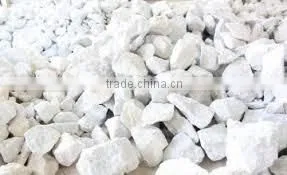
In the morning, stone moved to my factory, our staff began to classify and only select great stone with high whiteness, high brightness and specially super purity of CaCO3. All of this procedure are supervised by KCS department to choose stone puriest (98.5% CaCO3)
2. Clear the stone
Next, stone material is transferred up to basin. Here, the stone is washed clearly under extreme pressure spray of water.
3. Crushing
After clearing, tone moved to a jaw crusher for primary crushing and two cone crusher for secondary crushing. The output size is medium 10cm
4. Grinding
A hammer mill is a crusher that can grind, pulverize and crush a wide range of stones. This crusher employs a rain of hammer blows to shatter and disintegrate the material. The output size is 2-6 cm
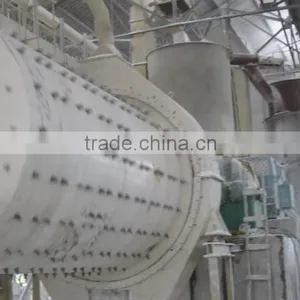
5. Ball Mill
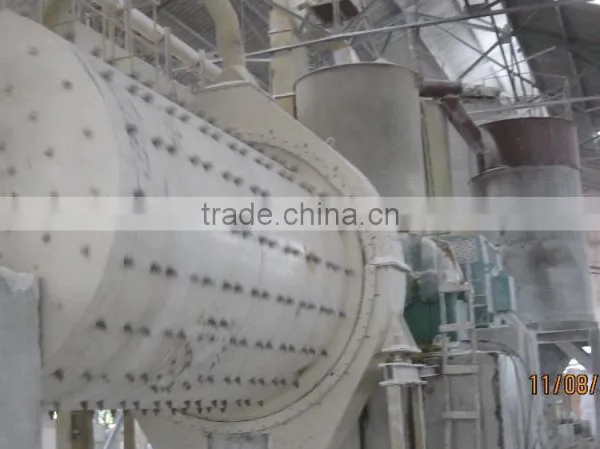
The Ball mill can be divided into lattice type and overflow type according to different beneficiation methods, and this machine is two lattice-type ball mill.
The materials from the feeding fittings enter the first bin of the milling machine via the feeding hollow axis evenly when it works. There is a ladder-like or ripple-like scaleboard in the first bin, and different specification steel balls are installed in the bin. When the cylinder rotates, which generating centrifugal force to carries steel balls to a certain height and then balls fall to strike and grind the material. After primary grinding in the first bin, the material then enters into the second bin via a single layer partition board. There is a scaleboard and steel balls in the second bin, so the materials are further ground. In the end, the powder is discharged by output material board.
Separator Air Classifier is a mechanical centrifugal air classifier, providing precise, efficient and reliable separations of stone powder. The micron separator is unique in the field of fine powder classification as it can be retrofitted to many popular grinders.
The rotor speed determines the centrifugal force; particle size can be easily adjusted by changing the rotor speed.
Can process up to 4,000 lbs/hour
Operates with efficiencies up to 90%
Classifies any material, organic or inorganic that can be spherical, flaky, and/or fibrous particles.
Classifying rotor uses the principles of fluid dynamics.
Closed circuit operation permits the grinding of heat sensitive materials or products with low softening points.
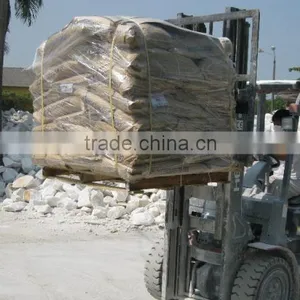
By PE bag, goods for longtime transportation.
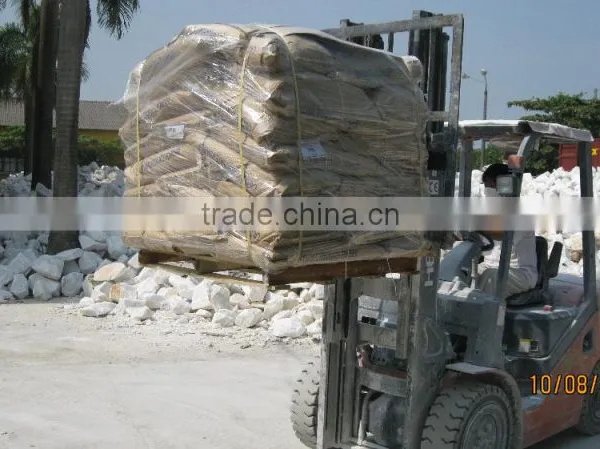
25 kgs/ bag, Palletized and Shrink Wrap
25.5 tons/Container.
10 Pallets of 1350 kgs and 10 pallets of 1200kgs
Bag: |
25kg/pp woven bag, 500kg or 1000kg ton bag or can be packed as customers' request |
Pallet: |
1 Pallet can be packed 40 bags by PE film/ 1 ton/ 40bags |
1x20' FCL: |
1x20' FCL can be loaded 20-22 Pallet/ 20-22 ton/800-880bags. 1x20' FCL can be loaded 24 ton/ 960bags without pallet |
Marks: |
If you have special requests on marks, we also can do |
Our Partner
About US
Established in 1984 , Huu Nghi Production - Trading Joint Stock company is a leading global producer of industrial minerals, mainly fillers and pigments derived from calcium carbonate, also in Welding Electrode and building construction. We have distributors and offices all over Vietnam and other countries such as Korea, India, China, Japan, Russia, Bangladesh...
Managers and leader is high degree
Staff is trained carefully.
The company‘s major markets are the paper, plastics, paint/coatings/adhesives industries as well as construction, environment, agriculture, food and cosmetic.
WHY CHOOSE US – HUU NGHI PRODUCTION TRADING JSC
1. Adopting dry surface treatment technique, with high activation rate.
2. Use professional equipment-Centrifuge, achieved full auto-operation,greatly increased the production.
3. Strict process inspection ,industrial grade caco3 MASTERSIZE test results achieved the level of inspection standard.
4.Product are stacked on the tray in the warehouse,effectively protect the goods be affected with damp.
Markets: India, Bangladesh, South Korea, UAE, Pakistan, Saudi Arabia, Nepal, Sri Lanka, Indonesia, Philippines…
Our Contact
Ms Giang (Jan)
Mobile: +84 1646508327
Skype: hagiang270187

Send Inquiry to This Supplier
You May Also Like
-
Wear‑Resistant TPU Granules Covestro 3660DU Virgin Extrusion Grade for Cable Sheath & Tubing ManufacturingUS$ 1.08 - 1.1MOQ: 1 Kilogram
-
Virgin PA66 588P Unreinforced Polyamide 66 Resin for Precision Injection MoldingNegotiableMOQ: 1 Kilogram
-
VALOX™ 357U Resin SABIC Innovative Plastics for Industrial ApplicationsNegotiableMOQ: 25 Kilograms
-
Customizable PVC Plastisol Sofubi Toy for Collectors and RetailersNegotiableMOQ: 500 Kilograms
-
Polymers & ResinsNegotiableMOQ: 2000 Bags
-
Economic Interlocking Horse and Cow Stable Mat Made of Rubber or EVAUS$ 13.5 - 35.4MOQ: 100 Pieces
-
SAP Super Absorbent Polymer for Sanitary Napkins or DiapersUS$ 1.5 - 2MOQ: 1000 Kilograms
-
Slip Additive Masterbatch With PE CarrierUS$ 2.3 - 2.5MOQ: 500 Kilograms
-
UHMW PE Powder for Lead-acid Battery SeparatorUS$ 2,750 - 2,850MOQ: 1 Ton
-
Pet Flakes Hot Wash / Pet Flakes Chip / Hot Washed Pet FlakesUS$ 650 - 680MOQ: 22 Tons


