








 Contact Platform Support
 Help Center
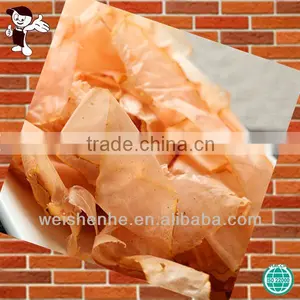
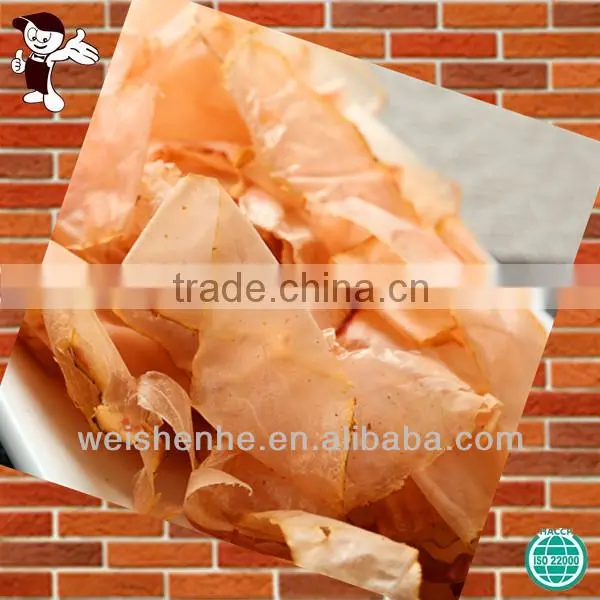
Dried Tuna Bonito Flakes


Related Products
Specifications
* Katsuobushi
* Made in Ch
* Small lot orders available
Japanese dried tuna bonito flakes Katsuobushi for dashi
Shipping possible for all orders including small lot orders
Shipping preparation is carried out quickly, and we offer flexible suppor
Product Description

- A base material made from processing fresh tuna sanitarily
- A unique taste and flavor achieved by ripening and smoking with oak
- The traditional natural seasoning of Japan adding deep taste, flavor and savor to food
- Delicate small and thin bonito flakes (aka hanakatsuo) used for topping in Japanese food
From Katsuo to Katsuobushi
Making great katsuobushi starts with selecting the right bonito (katsuo).
Selecting bonito suitable for katsuobushi requires knowing how to tell how fresh or fatty the fish is.
Maximum freshness and fattiness is excellent for the likes of sashimi, but not for katsuobushi.
Selecting the right fish requires many years of experience and learning.
Making Katsuobushi
1. Filleting
Unwanted parts of the fish—like the head, guts, and dorsal fin—are removed,
and what remains is filleted into katsuobushi’s basic form.
2. Basket Phase
The filleted bonito is arranged in a basket while undergoing a final check.
3. Simmering and Cooling
It is immersed in 80℃ water; then the temperature is raised to 98℃,
at which the fish is simmered for about an hour and a half.
It is then removed from the heating apparatus and is allowed to cool for about an hour and
a half (at this point the fish is called “namaribushi”).
4. Deboning and Skinning
The namaribushi is then skinned, and its bones are completely removed.
5. Dehydration (Baikan)
“Baikan” is a process of evaporating the moisture in the fish with smoke.
The fish is smoked repeatedly by burning sawtooth oak wood.
(These sessions are named "Ichibanbi", "Nibanbi", and "Sanbanbi",
literally meaning “first fire”, “second fire”, and “third fire”.)
6. Arabushi Is Made (Common or Low-Grade Katsuobushi)
This dehydrated product is called “arabushi.”
It is now sorted while controlling quality.
7. Drying & Aging
The arabushi is sun-dried for two to three days.
It is then aged in a cellar called a “kabimuro” (lit. “mold room”) at
a temperature of roughly 25℃ and humidity of 85%.
Blue mold begins to form after about 16 days,
at which time the fish is sun-dried for another two to three days.
A brush is then used to make sure the mold on the surface of the fish is evenly distributed.
The fish is then arranged in a shaded area with good ventilation,
where it can release any remaining heat it absorbed from the sun (cooling process).
This process is repeated four times.
At this point, the moisture level in the fish should fall below 18%,
and mold can no longer grow (we now have “honkarebushi”).
This is the fruit of much time and effort, as it takes at least six months to get to this point.
8. Honkarebushi Is Made (High-Grade Katsuobushi)
After the long six-month to one-year process described above, honkarebushi is made.
9. Bonito Flakes
When arabushi or honkarebushi is shaved, you get bonito flakes.
The most commonly sold bonito flakes are made from arabushi.
Flakes from honkarebushi are used as a precious ingredient.
Please feel free to inquire about any of our products.
Common Uses of Katsuobushi
Furikake
1. Over tofu
2. Over salad
3. Over fried rice
4. Over yakisoba
5. Over nimono (cooked vegetables, fish, and/or meat)
6. Over udon
7. Over rice
Dashi Soup Stock
8. Dashi stock for nimono (boiled or stewed dishes)
9. Dashi stock for udon
10. Dashi stock for nabe (hot pots)
Katsuobushi can be applied to a wide range of dishes.
We have our own processing factory with advanced machine line in the origin place.
We insist in “high quality” and “competitive price” and “good service".
company shows:

Send Inquiry to This Supplier

You May Also Like
-
New Automatic Feed Making Machine for Seafood MarketUS$ 800 - 2,000MOQ: 1 Set
-
SQUID POWDERNegotiableMOQ: 1
-
Kue Epinephelus Bruneus Longtooth GrouperUS$ 9,000 - 12,000MOQ: 1
-
Ultra Low Temperature Indicator for Frozen Food Packaging and MonitoringUS$ 65 - 130MOQ: 4 Pieces
-
Sea Bass - Barramundi - Tilapia - Red Drum Fish - Crisp Grass Carp - Snakehead Fish - Golden Pomfret - MackerelNegotiableMOQ: 10 Metric Tons
-
Brown CroakerNegotiableMOQ: 10 Metric Tons
-
Roasted Eel Unagi Kabayaki Eel (Anguilla Rostrata/Japonica)NegotiableMOQ: 5 Tons
-
Frozen Foods Chaoshan Cuttlefish BallNegotiableMOQ: 100 Cartons
-
Gadus Chalcogrammus Frozen Alaska Pollock,pollock Fish, Pollock 100-300,300-500gUS$ 0.1 - 0.3MOQ: 25 Tons
-
Frozen Silver Fish (Noodle Fish)US$ 7000 - 9000MOQ: 5 Metric Tons


