








 Contact Platform Support
 Help Center
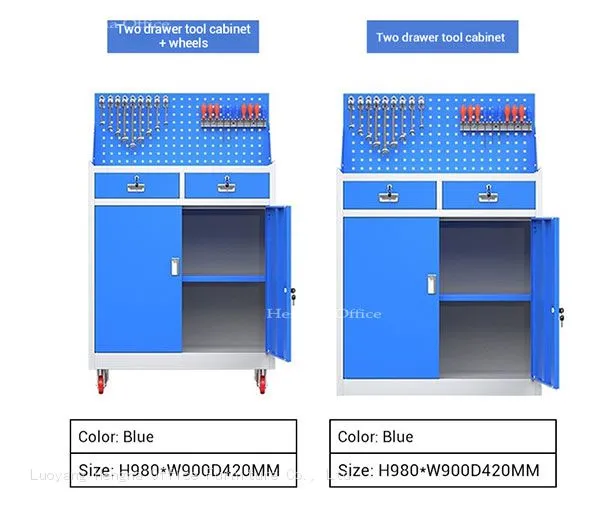
Workshop Tool Trolley With Drawers and Doors – Wide Body 1000mm | Find It Fast
Product Spotlights



Related Products
-
 Steel Tool Cabinet, Full-Width Deep Drawers – Ball-Bearing Slides | Precision ProtectedUS$ 60 - 120MOQ: 5 Combos
 -
5 Drawers Hardware Tool Truck | Wholesale Metal Tool Cabinet SupplierUS$ 99 - 269MOQ: 2 Cases
-
Multifunctional Mobile Tool Storage Box|Tool Cart With Handle and Wheels OEM ServicesUS$ 99 - 269MOQ: 2 Cases
-
Workshop Garage Metal Tool Cabinet| Mechanic Tool Storage Cabinet PriceUS$ 99 - 269MOQ: 2 Cases
-
Heavy Duty Steel Tool Cart With Drawers for Workshops|Hengna OfficeUS$ 99 - 269MOQ: 2 Cases
Workshop Tool Trolley with Drawers and Doors – Wide Body 1000mm | Find It Fast
Three trips for one belt change
A packaging plant in Rayong ran a sealing line that stopped twice that month — the same belt, the same failure. Both times the repair took under twenty minutes — and both times, the tech spent almost an hour getting to where the repair could start.
First trip: he walked back to the maintenance room for the socket set, because the cart at the line had only pliers and a flashlight. Second trip: the hex keys were in another tech’s locker. Third trip: the spare belts lived in a cabinet nobody had opened since the last audit — nobody could say which shelf. The production board counted every minute.
The maintenance lead did the math afterward and did not like it. The problem was not the tech. The problem was that the workshop had storage but not a strategy: tools distributed across a room, a locker, and a cabinet, and nothing that moved with the job.
The fix they settled on was a wide-body tool trolley assigned to the line — 1000mm of width, four full-size drawers plus a door cabinet, everything the sealing line needed on one cart that parked beside the machine. The next belt change took one trip and eighteen minutes. The line waited for the repair, not for the tooling.
That is the whole idea behind find it fast: the tools stop being a supply run and become a workstation.
Why width is the feature
Most tool carts are built around drawers sized for sockets and screwdrivers — small cells for small tools. Factory maintenance does not fit in small cells. A maintenance tech carries feeler gauges and a torque wrench, but also levels, long hex sets, gasket scrapers, adjustable wrenches up to 24 inches, and calibration tools that simply do not coil into a narrow drawer.
The wide body changes the geometry:
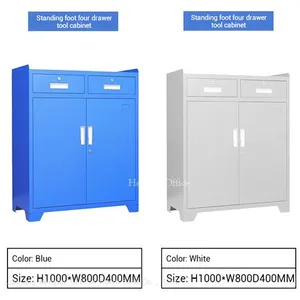
1000mm of drawer width — every drawer cell holds tools end-to-end in one visible layer. A 600mm wrench lies flat instead of diagonally. No digging.
500mm depth — full-size hand tools sit without overhang, and nothing hides at the back.
Four drawers, no micro-cells — wide drawers take divided trays for sorting, or stay open for clamps and strap wrenches.
A door cabinet for the awkward third dimension — spray cans, gasket compound, and spare parts boxes are tall, not flat. They belong behind a door.
The result: one glance covers one layer, and one layer covers one category. Search time goes from minutes to seconds — not because the tech got faster, but because the drawer got honest.
Drawers and doors: the maintenance split
Factory maintenance carries three tool families at once — mechanical, electrical, and consumables — and mixing them is how drawers turn into junk. The wide-body layout gives each family its own address:
| Zone | What lives there |
|---|---|
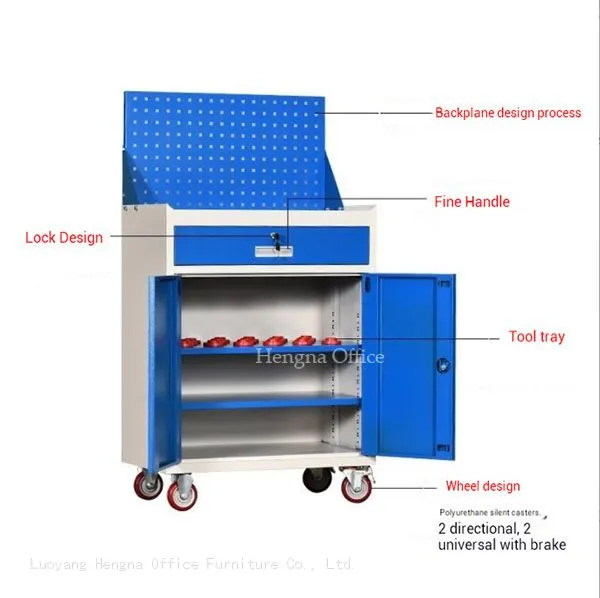
| Drawer 1 | Measuring and setting tools — feeler gauges, levels, calipers, alignment tools, laid flat and visible |
| Drawer 2 | Mechanical hand tools — wrenches, hex sets, pliers, gasket scrapers, in divided trays |
| Drawer 3 | Electrical side — insulated screwdrivers, multimeter, wire strippers, crimpers, terminal tools |
| Drawer 4 | Job support — torch, magnets, picks, cable ties, marking tools, gloves |
| Door cabinet | Consumables and spares — belts, fuses, contactors, lubricant sprays, gasket compound, fastener boxes |
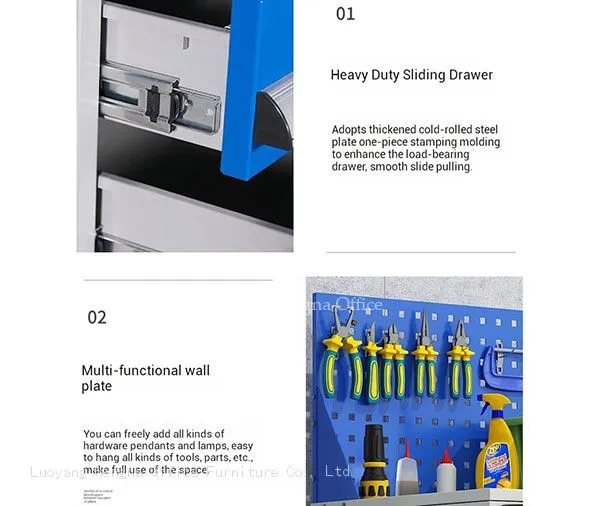
| Pegboard back | The tools in today’s rotation — hammer, pry bar, adjustable wrench, the current job’s drivers |
The split does more than organize. It keeps the calibrated tools away from the hammers, the electrical tools in their own dry zone, and the consumables restocked from one cabinet instead of five shelves. When a new tech joins, the cart teaches itself: read the labels, take the zone, close the drawer.
Labels that end the drawer-opening lottery
Every drawer front carries a label frame — a clear slot that holds a card listing what is inside. It sounds small. It is the difference between a system and a pile.
With labels, the tech heading to a breakdown knows before pushing the cart whether the torque wrench is on board. The night shift restocks from the label list, not from memory. And when a tool is missing, the label names the drawer that should have held it — so the search has an address instead of a rumor.
Cards can be handwritten, printed, or redone whenever the drawer’s job changes. The system bends to the shop; the shop does not bend to the system.
Built for the long walk across the plant
A maintenance cart in a real plant travels further in a week than a mechanic’s cart does in a month — from the maintenance room to the line, across expansion joints, over door thresholds, around corners built for forklifts and not for casters.
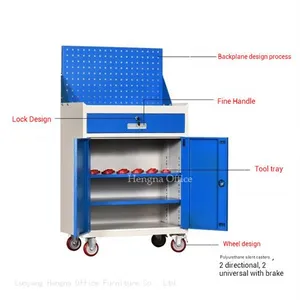
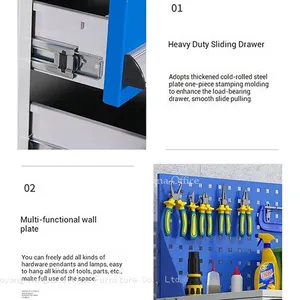
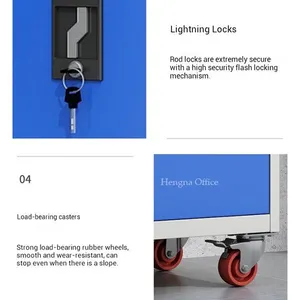
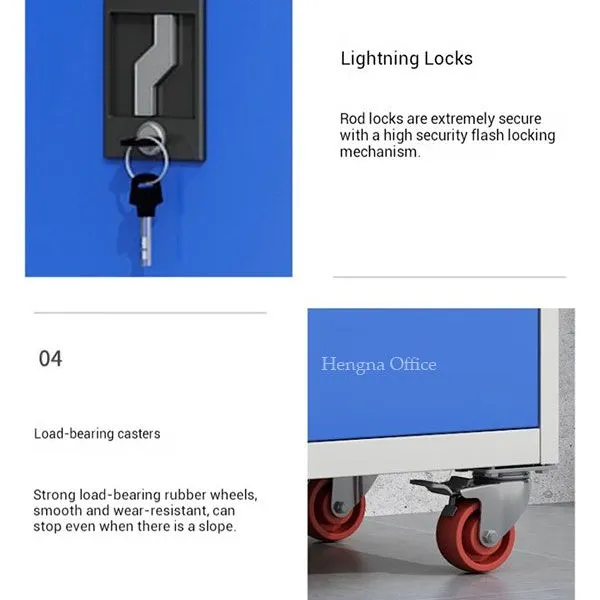
The cart is built for that route. Four polyurethane swivel casters roll over threshold strips and expansion joints without the rattle that shakes loose a neat drawer layout. The brakes lock the cart solid beside the machine — pull on a stuck fitting with the cart as your anchor. A side handle at mid-body keeps a fully loaded cart tracking straight down a long aisle, and the steel top deck is a work surface: strip the sensor there, lay out the belt tools, stage fasteners in removal order.
The body is cold-rolled steel, folded and welded into one frame that stays square through years of loaded pushing, and the phosphate-free powder coat wipes clean of the oil film and dust that come with plant work.
Who buys this trolley
Factory maintenance teams — The primary buyer. One wide cart per line or per zone, carrying the 90 percent of tools that 90 percent of jobs need, parked where the breakdowns happen.
Injection molding and packaging plants — Sealing lines, filling lines, mold changes — jobs that fail on a schedule and reward the crew that arrives complete.
Food and beverage plants — steel surfaces that wipe clean, tools zoned by task, consumables behind a door.
Cement, mining, and utility workshops — Long travel distances between buildings, where a second trip for a tool costs an hour, not a minute.
Contract maintenance providers — Crews that service client sites with their own kit: one labeled, locked, complete cart is a sales pitch in itself.
Factory-direct from Luoyang
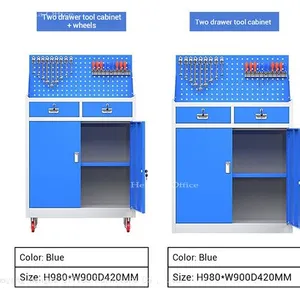
This workshop tool trolley is made by a steel furniture factory in Luoyang, China — the center of China’s steel furniture industry — and shipped to plants and distributors worldwide: Factory-direct pricing with drawings and configuration lists in every quote. KD flat-pack shipping for economical freight. OEM and ODM welcome — your color, your drawer layout, your label cards, your logo. Custom sizes and configurations for plant-wide standardization.
Whether you are equipping one critical line or standardizing a plant, the process is the same: send your tool list and route, confirm the configuration, receive the container.
Questions maintenance planners ask
Why 1000mm wide instead of a standard cart? Width is what makes one visible layer possible. Standard-width drawers force long tools to sit diagonally or overlap, which is exactly how digging starts. The wide body keeps every tool flat, visible, and reachable in one glance.
Can the label frames take printed cards? Yes — each drawer front has a clear card slot. Print your own list per drawer, update it whenever the drawer’s contents change, and the cart’s index stays accurate without repainting or engraving anything.
Will the drawers stay organized after restocking? The wide drawer format is what keeps restocking honest: one layer, one category, visible at a glance. A tool left out of place is obvious immediately, so the night shift corrects it in seconds instead of discovering it during a breakdown.
How does it handle door thresholds and rough floors? Four PU swivel casters absorb the threshold strips and expansion joints that rattle ordinary carts, the side handle keeps it tracking straight on long runs, and the brakes hold it solid beside the machine while you work against it.
Can we get one configuration for several lines? Yes. The drawer layout, color, and size are configurable. Many plants standardize on one layout across lines so any tech can walk to any cart and know where things are.
The cart that goes with the job
Downtime rarely waits on the repair. It waits on the walk — back to the room, to the locker, to the cabinet nobody restocked. A wide-body trolley with labeled drawers and a door for spares collapses that walk into one push. The tech arrives with everything, works off the top deck, and the line waits for parts and skill — not for tooling.
Send your tool list, your route, and your port. We will confirm the configuration, the labels, and the freight in one reply.

Send Inquiry to This Supplier



You May Also Like
-
OEM 3 Drawer Rolling Tool Cart With Side Handle for Garage & Workshop StorageUS$ 99 - 269MOQ: 2 Cases
-
Wholesale 3-Drawer Tool Trolley With Wheels for Factory and Garage StorageUS$ 99 - 269MOQ: 2 Cases
-
Warehouse Steel Shelving for Emergency Response Tools and Supplies|Hengna OfficeUS$ 5 - 120MOQ: 2 Cases
-
HN-wlj160 Industrial Rolling Tool Organizer With Pegboard|All-in-One Mobile Tool Storage CartUS$ 5 - 120MOQ: 2 Cases
-
Trustworthiness Workshop Tool Organizer on Wheels With Pegboard Back PanelLuoyang Hengna FactoryUS$ 5 - 120MOQ: 2 Cases
-
JUNTUO-GJC Heavy Duty CNC Tool Cart With Lockable Drawers for Machine Shop EfficiencyUS$ 99 - 269MOQ: 2 Cases
-
Heavy-Duty Rolling Tool Cabinet With Drawers | Industrial Steel Tool Storage for Garage 36" H x 24" W x 18" DUS$ 99 - 269MOQ: 2 Cases
-
Large Capacity Industrial Tool Chest on Wheels | Mobile Metal Storage Cabinet for Mechanics| Drawer Height|130mm (5.1 Inches) EachUS$ 99 - 269MOQ: 2 Cases
-
Juntuo-GJC081 Professional Workshop Rolling Tool Box | Heavy-Duty Tool Cabinet With 4 Polyurethane WheelsUS$ 99 - 269MOQ: 2 Cases
-
MT-H2D & MT-L2D Metal Tool Chest for Garage Mechanics – Lockable Rolling Tool Cabinet With PegboardUS$ 99 - 269MOQ: 2 Cases

