








 Contact Platform Support
 Help Center
Paraffin Block Cabinet HN-BC400 — 3,710 Blocks Per Section, Stackable Steel Histology Cabinet | OEM
Product Spotlights



Related Products
-
 Histology Paraffin Block Cabinet — Cold-Rolled Steel, Stainless Steel Base, Moisture-Resistant Slide and Block Storage | 1-Yr WarrantyUS$ 289 - 600MOQ: 5 Combos
 -
0.8MM Cold Rolled Steel Paraffin Block Cabinet With Quiet Rails — Moisture-Proof Base for Hospital Pathology LabUS$ 299 - 499MOQ: 1 Piece
-
Tissue Block Archive Cabinet With Drawer Slides - Moisture-Proof Base Transparent Window Epoxy Coated Light Gray Biology Lab StorageUS$ 199 - 519MOQ: 1 Piece
-
Paraffin Block Storage Cabinet Modular Sectional Design - Stainless Steel Base Quiet Buffer Slides White Pathology DepartmentUS$ 99 - 539MOQ: 1 Piece
-
Cassette Storage Cabinet 0.8MM Cold Rolled Steel - Multi-Specification Drawers Heavy Duty Rails Epoxy Coated Silver Gray for Medical LaboratoriesUS$ 99 - 599MOQ: 1 Piece
Paraffin Block Cabinet HN-BC400 — 3,710 Blocks Per Section, Stackable Steel Histology Cabinet | OEM
What 3,710 blocks per section means for a working histology lab
A histology technician processes tissue in batches. Each batch — 20, 40, or 60 cassettes — comes out of the embedding center, goes through microtomy, and moves to storage. Over a year, a mid-volume lab running 15 to 20 blocks per day generates roughly 4,000 to 5,000 blocks. A high-volume lab processing 40 to 60 blocks per day clears 10,000 to 15,000 blocks annually.
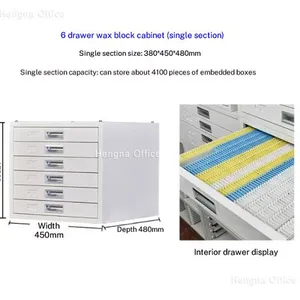
Storage fills faster than most lab managers expect. A single HN-BC400 section holds 3,710 paraffin blocks. That is one year of output for a mid-volume lab, or six months for a high-volume lab. A 4-section stack holds 14,840 blocks — roughly three years for the mid-volume lab and one to two years for the high-volume one.
The cabinet is not sized for a theoretical maximum. It is sized for the actual filing rate of a histology lab running a standard caseload.
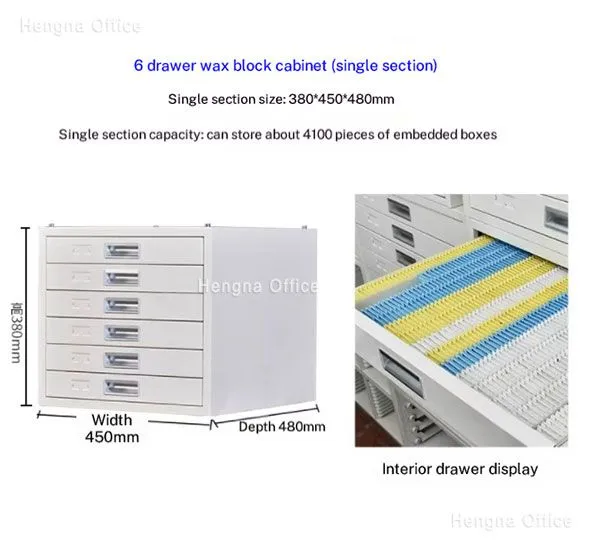
The drawer grid — each block in its own slot
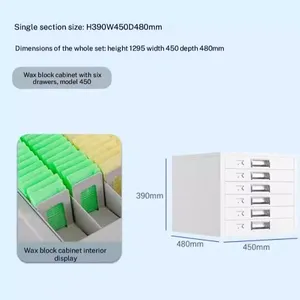
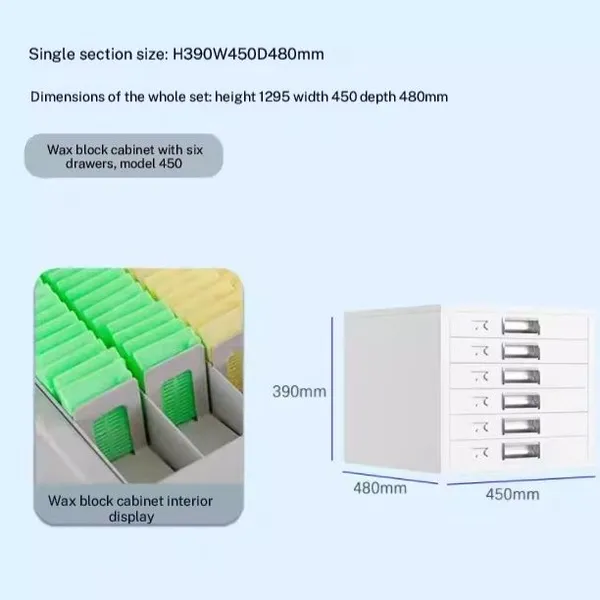
Paraffin blocks are stored vertically in partitioned grid slots. Each slot is sized for a standard 7 mm embedding cassette. The partition walls prevent blocks from leaning against each other, which means the wax surface — where the tissue section is cut from — does not come into contact with the adjacent block.
In a drawer without partitions, blocks settle to one side during opening and closing. The friction between blocks abrades the wax surface. Over months of repeated access, blocks lose surface definition, and the technician has to trim more wax before cutting, wasting tissue.
The HN-BC400 drawer uses full-height dividers that run the full depth of the drawer. Each block has its own cell. When the drawer is pulled out, the blocks stay standing. When the drawer is pushed in, they stay aligned.
The grid layout also prevents mix-ups. Each cell holds one block. In a dense storage system where blocks sit side by side, the wrong block can be pulled by mistake — the technician grabs one cassette and a neighboring cassette comes with it, or two blocks slide together and the label faces away. With individual cells, each block is separate and the label faces the technician.
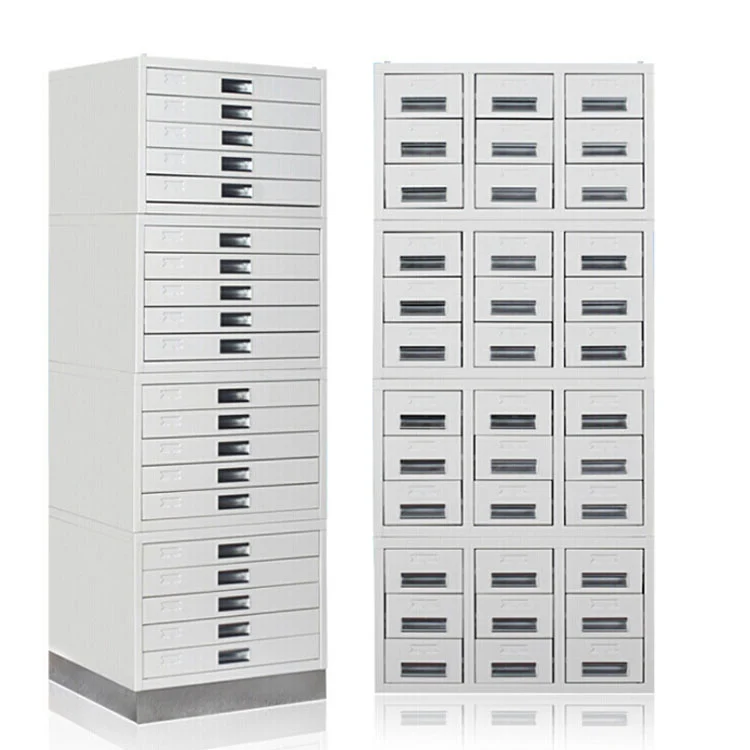
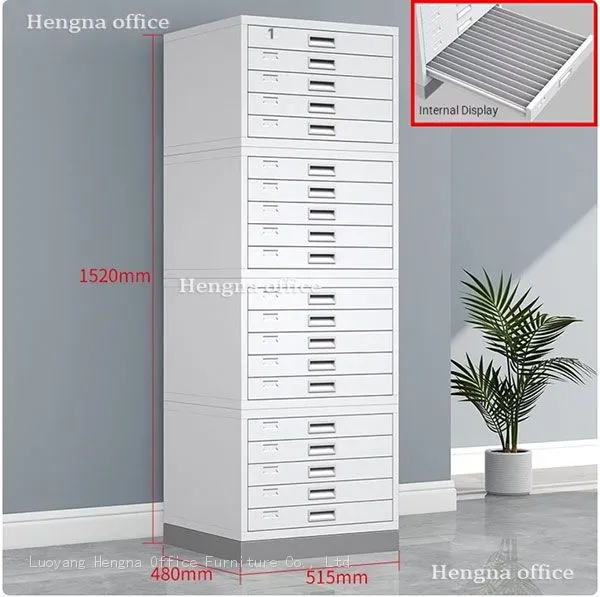
HN-BC400 specifications: one section, 3,710 blocks, stackable
| Parameter | Value |
|---|---|
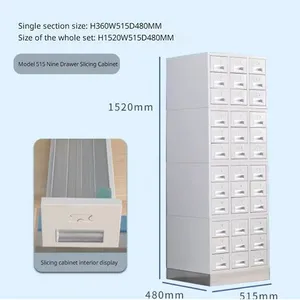
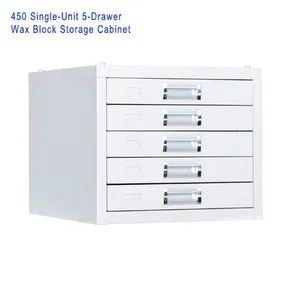
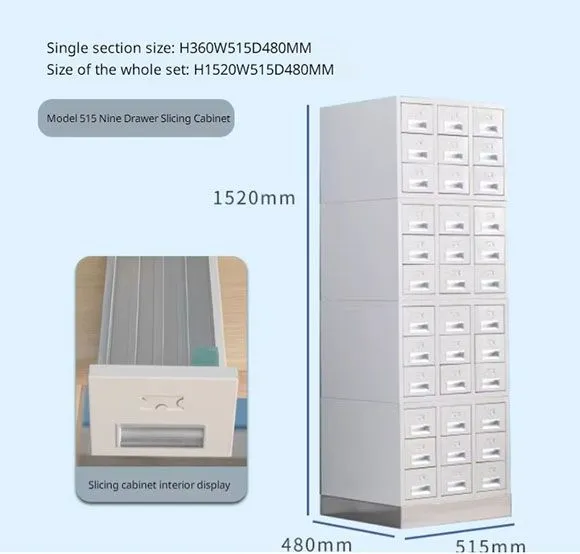
| Single section dimensions | H360 × W515 × D480 mm |
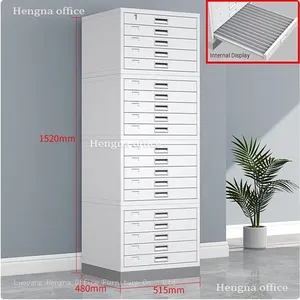
| 4-section stack height | H1,520 mm |
| Material | Cold-rolled steel, electrostatic powder coating |
| Standard color | Medical white, light gray |
| Base | Stainless steel base plate on 4-section stacks |
| Capacity per section | 3,710 paraffin cassettes (7 mm standard) |
| Drawer slides | Full-extension ball-bearing, silent close |
| Label system | Transparent pocket on each drawer front |
| Assembly | Ships fully assembled |
| Certification | CE |
| OEM | Custom colors, logo silk-screen, custom drawer layout |
| Packaging | Moisture film + foam corner protectors, assembled carton |
A 2-section stack is 720 mm tall — fits under a standard lab bench. A 3-section stack is 1,080 mm. A 4-section stack is 1,520 mm — just under waist height for a standing technician.
Stackable by design, not by adaptation
Some modular cabinets use the same frame for slides and blocks with interchangeable inserts. The HN-BC400 is a dedicated block cabinet. The drawer depth, partition height, and slot width are designed specifically for 7 mm paraffin cassettes. A slide cabinet drawer is shallower and uses slot racks instead of grid partitions. The two products share the same outer dimensions but are not interchangeable at the drawer level.
The stackable frame works the same way for both. Each section has alignment pins on the top surface and matching receivers on the bottom. Stacking a second section means placing it on top, aligning the pins, and tightening four bolts. The sections ship assembled — no drawers to install, no panels to attach.
For a lab that starts with blocks and later adds slide storage, the slide cabinet sections (HN-BC400-S) use the same stacking system and the same footprint. The two product lines integrate in a single column.
Label retrieval: finding a block three years later
A paraffin block's storage life depends on the lab's retention policy. Hospital pathology departments in most countries retain blocks for 7 to 10 years after the last patient encounter. Research labs may keep them indefinitely. Finding a block from three years ago requires a storage system where labels stay readable and access is predictable.
The HN-BC400 uses transparent label pockets on each drawer. The pocket is a clear PVC sleeve bonded to the drawer front. A printed label — block ID range, case number range, or date range — slides into the sleeve. The label does not contact the drawer surface, so it does not get smeared by gloved hands.
For labs using barcode-based block tracking, the pocket accepts a barcode card. The lab assigns each drawer a barcode, scans it at the cabinet face, and the inventory system returns the block location. No need to open drawers to scan interior labels.
The grid slot layout supports numerical or chronological filing. Blocks are filed from front to back within each slot, and slots are numbered sequentially. A 3,710-block section organized by accession year means each year's blocks occupy a known range of drawers.
How histology labs use the HN-BC400
Routine surgical pathology. A hospital histology lab processes surgical specimens — biopsies, resections, excisions. Each case generates 3 to 10 blocks on average. The HN-BC400 section holds roughly 370 to 1,200 cases, depending on block count per case. Filing is chronological by accession number. Each section covers a defined range.
IHC and special stains lab. Immunohistochemistry labs receive pre-cut slides from the main lab and produce stained slides for pathologist review. The original blocks are stored in block cabinets in the main lab, but IHC labs often keep a reference set of control blocks for each antibody batch. A single HN-BC400 section holds hundreds of control blocks with room to expand.
Research tissue bank. Academic and pharmaceutical research labs accumulate tissue blocks from multiple studies. Blocks are filed by study number rather than accession number. The HN-BC400's grid layout supports filing by study, with each drawer holding one study or a study sub-set. Label pockets are color-coded — green for active studies, blue for completed, red for expired.
Off-site block archive. Hospitals running out of on-site storage send blocks to an off-site facility. The HN-BC400 stacks in archive rooms with high-density racking. The assembled cabinet can be forklifted onto shelving without disassembly. Multiple 4-section stacks in a single room hold 50,000 to 100,000 blocks.
OEM: not just a color change
The standard HN-BC400 ships in medical white or light gray. OEM orders extend beyond color.
Custom label holder position. Some labs want the label pocket on the drawer side instead of the front, so labels are visible from a side angle when multiple cabinets are positioned side by side. The pocket position can be changed during production.
Custom drawer grid layout. For labs that use non-standard cassette sizes — biopsy cassettes are sometimes shorter than standard 7 mm cassettes — the partition spacing can be adjusted. The grid cells become narrower to fit more smaller cassettes, or wider to accommodate double-width cassettes.
Silk-screen logo. Hospital pathology departments receiving blocks from multiple referring clinics sometimes label cabinets with the referring clinic name. The logo is screen-printed on the cabinet door frame.
Custom color. Pantone-matched powder coating. Minimum order 50 sections for color change.
Packaging for project delivery. For new lab construction or lab relocation projects where multiple cabinets arrive at the same time, bulk palletizing and sequential numbering of crates reduce unpacking time.
FAQ
What size cassettes fit in this cabinet?
Standard 7 mm paraffin embedding cassettes. For biopsy cassettes that are shorter than 7 mm, the grid slots hold up to 25% more per drawer because the cassettes are narrower.
How many sections fit under a standard lab bench?
Two sections (720 mm total height) fit under a standard 900 mm lab bench. Three sections (1,080 mm) require a clearance check.
Do the slide cabinet sections use the same stackable frame?
Yes. The slide cabinet (HN-BC400-S) has the same 360 × 515 × 480 mm footprint and the same frame. Mix block and slide sections in the same stack.
What is the MOQ?
One section for standard configurations. Custom color or logo: 50 sections minimum.
How are the cabinets shipped?
Ships assembled. One section per carton. Moisture-barrier film, foam corner protectors. Multiple cartons on a pallet for freight.
Is the cabinet CE certified?
Yes.
Can I get a sample section before ordering?
Photo with scale reference and 360-degree video provided. Physical sample available for self-paid shipping to your address.
What is the warranty?
One year against manufacturing defects. Covers frame, drawer slides, and powder coating.
How long does production take?
Standard: 7–15 days. OEM (color or logo): 20–30 days. Quote within 24 hours.
Luoyang Hengna Office Furniture Co., Ltd.
Nine years of medical storage equipment production. The HN-BC paraffin block cabinet series is manufactured in Luoyang, China, and exported directly — no distribution layers. Standard sections ship from stock. OEM projects accepted from single-unit to facility-scale orders. For a quotation, specify the section quantity, any custom requirements, and the destination. Response within 24 hours.

Send Inquiry to This Supplier



You May Also Like
-
Paraffin Block and Cassette Cabinet Cold Rolled Steel 0.8MM – Multi-Drawer Modular Moisture-Proof Base Epoxy Coated White for PathologyUS$ 119 - 499MOQ: 1 Piece
-
Pathology Block Cabinet With Drawer Design – High Elastic Buffer Slides, Silver Glass Slide and Cassette Storage for Hospitals and Biology LabsUS$ 119 - 699MOQ: 1 Piece
-
Hengna Paraffin Block Cabinet | 30 Drawers Steel & Fire-Resistant | Hospital Pathology Lab - OEM SupplierUS$ 289 - 600MOQ: 5 Combos
-
Cassette Cabinet | Lockable & Moisture-Proof | Biomedical Research Lab - Factory DirectUS$ 289 - 600MOQ: 5 Combos
-
Paraffin Block Storage | Divided Compartments & Durable Construction | Clinical Specimen Management - B2B ManufacturerUS$ 289 - 600MOQ: 5 Combos
-
Hengna Laboratory Block Cabinet | Customizable | Pharmaceutical R&D Facility - ODM FactoryUS$ 289 - 600MOQ: 5 Combos
-
Veterinary Paraffin Cabinet | Anti-Corrosion & Secure Design | Animal Diagnostic Center - Direct SupplierUS$ 289 - 600MOQ: 5 Combos
-
Medical Cassette Storage | Easy-Access & Stackable System | University Teaching Lab - OEM/ODMUS$ 289 - 600MOQ: 5 Combos
-
Pathology Block Cabinet | High Capacity & Temperature Control | Third-Party Testing Agency - B2B SupplierUS$ 289 - 600MOQ: 5 Combos
-
Clinical Specimen Cabinet | Fire-Rated & ISO Compliant | Hospital Research Department - Factory OutletUS$ 289 - 600MOQ: 5 Combos


