








 Contact Platform Support
 Help Center
Main Frame Auxiliary Frame Steel Rack — Expand Rows, Save Column Cost, KD Pack for Bulk Order
Product Spotlights



Related Products
-
 Versatile Medium Duty Warehouse Shelving System With 300kg Adjustable Capacity| for Distribution Centers and Retail BackroomsUS$ 1 - 330MOQ: 5 Sets
 -
Industrial-Grade Adjustable Shelving Unit With 300kg Load Capacity per Shelf|Hengna OEM FactoryUS$ 1 - 330MOQ: 5 Sets
-
Industrial Storage Rack 400kg Per Tier - Heavy Duty Expandable Shelving System for Warehouse & Manufacturing FacilitiesUS$ 1 - 330MOQ: 5 Sets
-
400kg Capacity Multi-Purpose Industrial Shelving Unit - Versatile Storage Solution for Supermarket, Library & Commercial SpacesUS$ 1 - 330MOQ: 5 Sets
-
Industrial Strength Shelving System 400kg Capacity Per Level - Heavy Duty Supermarket Storage Rack for Retail Space OptimizationUS$ 1 - 330MOQ: 5 Sets
You're pricing out a warehouse fit-out. Thirty bays, row after row, floor to ceiling. You pull up rack specs, multiply by thirty, and the number lands somewhere between "this works" and "I need to explain this to someone." Then you look closer at the quote — every single bay is a main frame. Two uprights per bay, sixty uprights total. Every upright is a column of cold rolled steel with double-row diamond holes, phosphate-treated, powder-coated, wrapped for shipping. They're not free.
Now look at an auxiliary frame. One upright per bay. Same steel, same holes, same coating — but you only need one, not two, when it shares an upright with the bay next to it. For thirty bays lined up, that's one main frame on the left end, one main frame on the right, and twenty-eight auxiliary frames in between. Two uprights on each end, one upright per interior bay. Total uprights: thirty-two. Instead of sixty. You just cut the upright count nearly in half.
That math is the main-and-auxiliary system. It's not a premium add-on — it's the default way to buy steel racking at scale, unless your supplier doesn't explain it to you, or they'd rather sell you sixty uprights.
How it actually connects
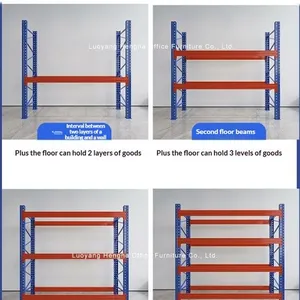
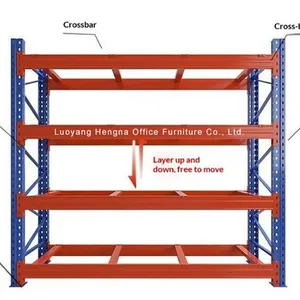
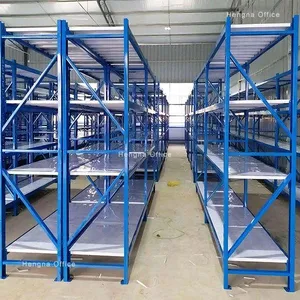
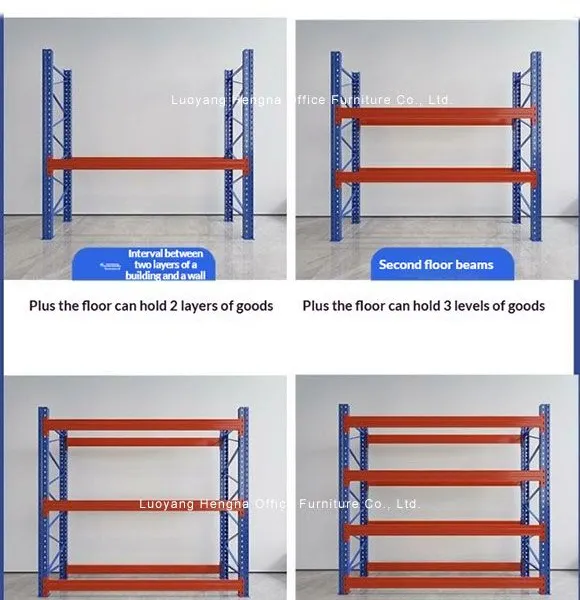
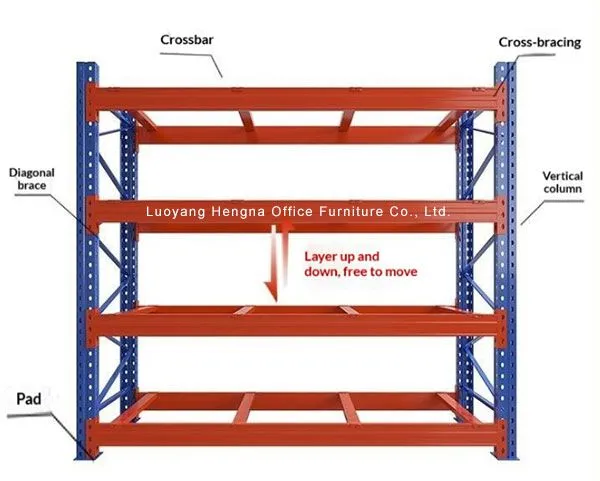
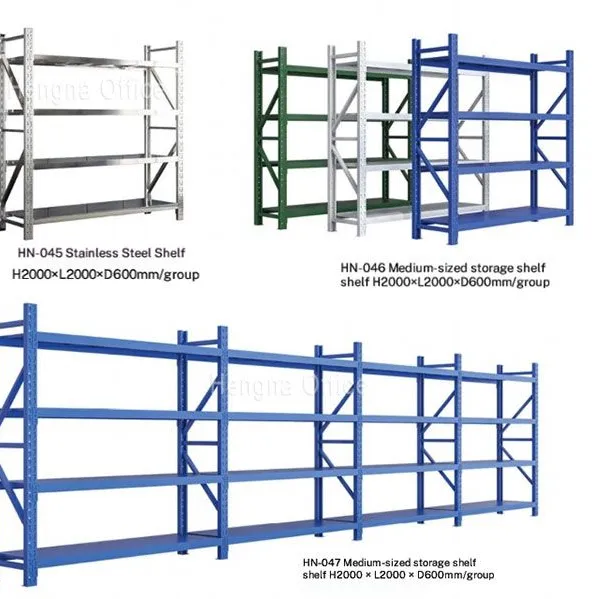
A main frame stands on its own. Two uprights, one left side, one right side. Crossbeams bridge the gap. Shelves sit on the beams. On the floor, it's a standalone bay — use one, and you're done.
An auxiliary frame only has an upright on one side. None on the other. Where does the other side go? It shares the adjacent bay's upright. The crossbeams on the auxiliary frame lock into the same upright the neighboring main frame is already using. One upright, serving two bays at the shared edge.
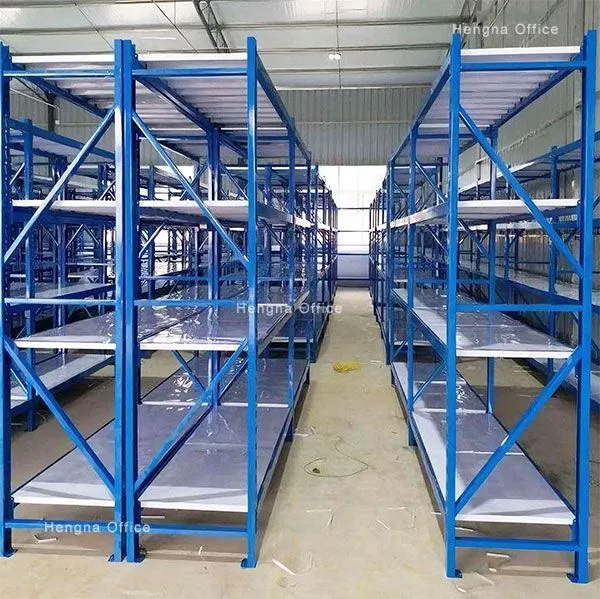
Row by row, the system stacks: main frame, auxiliary frame, auxiliary frame, auxiliary frame — as many as you need — then a closing main frame at the far end. The leftmost upright and rightmost upright are the only ones that stand alone. Every interior upright pulls double duty.
The connection is the same butterfly clip across the entire system. Same diamond holes, same snap-in mechanism, same tool-free assembly. The only thing that changes is how many uprights you're paying for. Everything else — shelves, beams, braces, clips, base plates — stays the same across main and auxiliary frames.
The money you don't spend on steel
Here's what the upright savings look like at real-world scale.
| Bays | Main frames only (uprights) | Main+Auxiliary (uprights) | Uprights saved |
|---|---|---|---|
| 5 | 10 | 6 | 4 |
| 10 | 20 | 11 | 9 |
| 20 | 40 | 21 | 19 |
| 30 | 60 | 31 | 29 |
| 50 | 100 | 51 | 49 |
Every upright saved is cold rolled steel, four-step surface treated, packed individually, shipped across an ocean — with a cost attached to each of those steps. At ten bays, nine fewer uprights. At thirty, twenty-nine fewer. At fifty, forty-nine fewer. The number isn't a discount percentage. It's steel you never ordered, never shipped, never paid for.
And the auxiliary frames don't reduce your shelf count. They don't reduce the load capacity. They don't change the way the rack performs. Six crossbeams, four shelves, diagonal bracing — everything that carries weight is identical between main and auxiliary. The only thing missing is the second upright, because the bay next door is already supplying one.
KD pack — what bulk order shipping actually looks like
When you order a main-plus-auxiliary system at container scale, the packaging matters almost as much as the product. A 40-foot container holds a certain cubic volume — and how efficiently you pack it determines shipping cost per bay.
KD means knocked down. Every upright is separated from every beam. Every shelf panel is flat-stacked, not assembled. Every component is an individual flat piece that stacks with its identical siblings — beams with beams, shelves with shelves, uprights with uprights — until the container is filled like a filing cabinet. No assembled frames taking up empty air.
Each piece is wrapped in moisture-protection film. Steel crossing an ocean picks up condensation without it — rust starts before the rack reaches your dock. Corner protectors on every upright edge and shelf corner prevent dings during transit and handling. All hardware — butterfly clips, base plates, bracing connectors — is bagged by type, labeled by frame (main or auxiliary), and packed with a manifest that matches what's on the floor.
The result: the container lands, your team opens it, and every component is organized by what it is and where it goes. Main frame uprights in one stack. Auxiliary uprights in another. Crossbeams separated from shelves. Clips bagged and tagged. No mixed pallets, no hunting through identical silver parts to figure out what belongs where.
For a fifty-bay system, that organized packing saves you a day of sorting on the receiving end. You unload by labeled stack, distribute to aisle locations, and start assembly immediately.
The rack specs
| Item | Detail |
|---|---|
| Frame types | Main frame (2 uprights) and auxiliary frame (1 upright) |
| Tiers per bay | 4 (custom 3/5/6 available) |
| Load per shelf | 100-200kg |
| Material | Cold rolled steel |
| Shelf structure | 4 longitudinal reinforcement ribs per panel |
| Connection | Butterfly clip, boltless, tool-free |
| Surface finish | Acid wash → phosphate → sand blast → electrostatic powder coat |
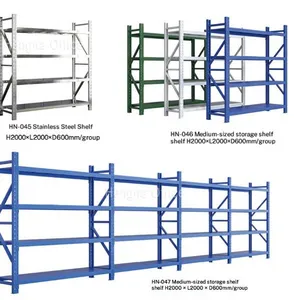
| Colors | Blue / White / Black / Black-Yellow |
| Packing | KD each component, moisture film + corner protectors + labeled bags |
| Certification | CE |
Cold rolled steel throughout — uprights, beams, shelf panels. Not hot rolled. Cold rolled holds tighter tolerances, which matters when you're snapping thirty bays of butterfly clips into diamond holes that all need to align. A half-millimeter gap on one upright compounds across a row. Cold rolled keeps every component within spec. The four-step powder coat process — acid wash, phosphate, sand blast, powder cure — protects every upright, beam, and shelf across the entire system. No single coat of paint on any component.
Where the system makes sense
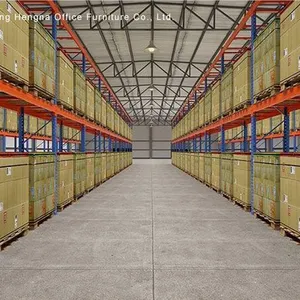
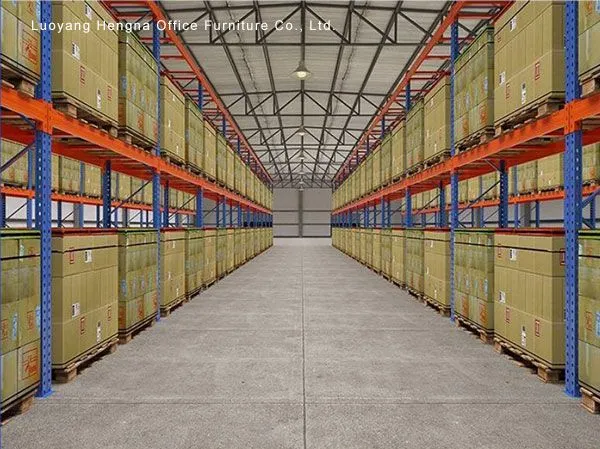
Large warehouse fit-outs — distribution centers, 3PL warehouses, cold storage facilities. When you're building out multiple rows with dozens of bays, the upright savings from auxiliary frames are the difference between coming in under budget and going back for approval on the overrun.
Retail chain rollouts — same rack system across multiple store backrooms. Design it once, order it in bulk, auxiliary frames cut cost per store. KD packing means each store receives its component set labeled and ready to assemble, not a mixed shipment that needs resorting.
Logistics and fulfillment centers — high-density rack rows where every bay touches the next. Nearly all interior bays run on auxiliary frames because they share uprights with both adjacent bays. One row of forty bays: two main frames, thirty-eight auxiliary. That's thirty-eight uprights you didn't buy.
Manufacturing and assembly plants — raw material racking along production lines, finished goods staging at the end of the line. Auxiliary frames let you extend the row as production scales without buying full standalone bays. Add an auxiliary frame at the end, close with a main frame, keep going.
Temporary and pop-up warehousing — peak season overflow, project-based storage, event warehousing. The KD system ships flat, assembles fast with butterfly clips, and the auxiliary frame approach means you're not overinvesting in uprights for a temporary setup. When the season ends, disassemble, stack flat, store until next year.
FAQs
How do I calculate how many main and auxiliary frames I need? One main frame at each end of every row. Everything in between is an auxiliary frame. If you have three rows of twenty bays each: six main frames total (two per row), fifty-four auxiliary frames. Send us your layout and we'll confirm the count before you order.
Does an auxiliary frame hold the same weight as a main frame? Yes. The shelves, beams, and load-bearing components are identical. The only difference is the number of uprights — one instead of two — because the second upright is shared with the adjacent bay. Load capacity per shelf is unchanged: 100-200kg.
Is assembly any different for auxiliary frames? No. Same butterfly clip connection, same snap-in process, same tool-free assembly. The auxiliary frame crossbeams clip into the existing upright of the adjacent bay on the shared side, and into the auxiliary's own upright on the other side.
What's the MOQ for a main-plus-auxiliary order? Single main frame available. Auxiliary frames require at least one main frame to connect to. For full container loads, we optimize the KD pack layout to maximize density and minimize shipping cost per bay. Custom colors and OEM have separate minimums.
How is a fifty-bay system packed? KD. Uprights stacked by type (main vs auxiliary), shelves flat-packed in stacks, beams separated by length, all hardware bagged and labeled by frame type with a manifest. Moisture film on every steel component, corner protectors on every edge. Container utilization is planned before packing starts — we confirm the count, calculate the cube, and optimize the load plan.
Lead time? Standard colors: 7-15 days for typical bay quantities. OEM, custom colors, or large orders: 30-45 days depending on volume and spec.
FOB, CIF, DDP? All available. FOB Qingdao/Tianjin, CIF to your port, DDP to your location. Your logistics, your terms.
OEM and branding? Silk-screen logos on uprights, custom packaging with your brand, custom assembly manuals in your language, custom color combinations, non-standard bay widths and heights. Nine years of export experience.
Luoyang Hengna Office Furniture Co., Ltd. — manufacturer-direct supply. Nine years in industrial steel rack export, CE certified. Quote within 24 hours — send your layout dimensions, number of rows and bays, and load requirements. You'll get a breakdown with main and auxiliary counts, KD packing plan, and shipping estimate. Not a catalog page, not a price list — a quote for exactly what you're building.

Send Inquiry to This Supplier


You May Also Like
-
400kg Load Capacity Industrial Racking System - Warehouse Heavy Duty Storage Unit With Butterfly Hole Plug-In DesignUS$ 1 - 330MOQ: 5 Sets
-
Multi-Layer Industrial Storage Unit 400kg Per Shelf - Space-Saving Library Shelving Solution With Freely Adjustable LayerUS$ 1 - 330MOQ: 5 Sets
-
Robust Industrial Storage Solution- Heavy Duty Medical Shelving Rack for Hospital Clinics and Healthcare FacilitiesUS$ 1 - 330MOQ: 5 Sets
-
Heavy Duty Steel Shelving Bay 200kg Capacity - Industrial Workshop Storage Rack With Butterfly Snap DesignUS$ 1 - 330MOQ: 5 Sets
-
Heavy Duty Parts Storage Rack 300kg Capacity - Workshop Organizer With Main-Subframe DesignUS$ 1 - 330MOQ: 5 Sets
-
Industrial Parts Shelving System 300kg Load Capacity - Garage Storage Solution With Four Reinforcement BarsUS$ 1 - 330MOQ: 5 Sets
-
Customizable Parts Organizer 300kg Per Shelf - Multi-Size Workshop & Factory Storage Rack With High-Quality Cold Rolled SteelUS$ 1 - 330MOQ: 5 Sets
-
Space-Saving Parts Storage Unit 300kg Capacity - Warehouse & Courier Shelving System With Free Combination Main-Subframe DesignUS$ 1 - 330MOQ: 5 Sets
-
Industrial Modular Warehouse Shelving - Heavy Duty Storage Rack With Chipboard Deck for Factory & Workshop OperationsUS$ 1 - 330MOQ: 5 Sets
-
Space-Saving Modular Storage System 300kg Load Capacity - Warehouse Shelving Unit for Logistics & Inventory ManagementUS$ 1 - 330MOQ: 5 Sets


