








 Contact Platform Support
 Help Center
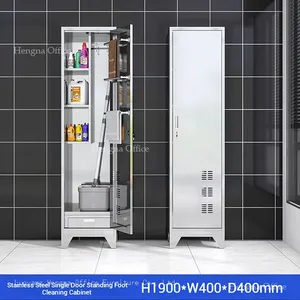
Industrial Cleaning Cabinet With Ventilation — Stainless Steel, Lockable, Built for Warehouse Floors, 20×16×71 in
Product Spotlights



Related Products
-
 Hotel Janitorial Cabinet Double Door — Where Back of House Tells No LiesUS$ 80 - 200MOQ: 5 Combos
 -
Double Door Mop Cabinet With Drain Pan — A Wet Mop Shouldn't Outlive the Cabinet It Sits InUS$ 80 - 200MOQ: 5 Combos
-
Cold Rolled Steel Janitorial Cabinet | With Ventilation Holes, Adjustable Shelves | for Toronto Ontario SchoolUS$ 100 - 350MOQ: 5 Sets
-
Vancouver Grade Locking Custodial Supply Closet for Schools|Grey Double Door Metal Cabinet With Mop HooksUS$ 100 - 350MOQ: 5 Sets
-
Heavy Duty Locking Custodial Locker|Welded Steel Construction, Putty Color| for Montreal Quebec InstitutionsUS$ 100 - 350MOQ: 5 Sets
This Cabinet Lives on the Warehouse Floor, Not in Some Office Closet
Most janitor cabinets are designed for carpeted hallways and break rooms. That's fine if you're an office manager. But if you're running a warehouse floor, you know the difference.
Your cleaning cabinet sits near the loading dock, right next to the floor scrubber station. It's in a concrete room with a floor drain. The air is cooler in winter, hotter in summer, and the humidity changes with every truck that opens the bay door. Mops, chemicals, rags, spill kits — they all go in and out every few hours. And if the cabinet isn't designed for that environment, it won't last two years.
This cabinet is. Let's get into why.
What "Built for Warehouse Floors" Actually Means
Ventilation That Exists for a Reason
A lot of cabinets have ventilation slots because they look industrial. On this cabinet, they serve a function.
Warehouse cleaning involves water. Floor scrubbers dump dirty water. Mops get soaked. Rags go in wet and come out wetter. If that moisture stays trapped inside a closed cabinet, three things happen:
The cabinet starts to smell. Not just musty — genuinely unpleasant.
Fabric tools degrade faster. Mop heads that stay damp for 24 hours break down in weeks, not months.
Metal surfaces inside the cabinet can develop surface corrosion over time — not because the steel is bad, but because the environment is hostile.
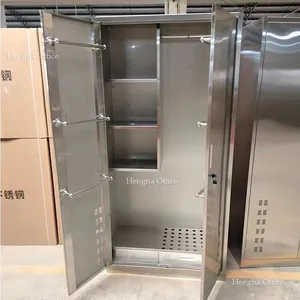
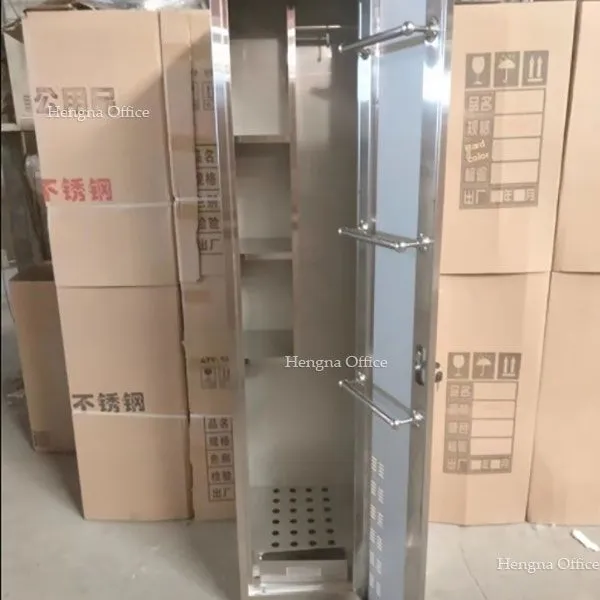
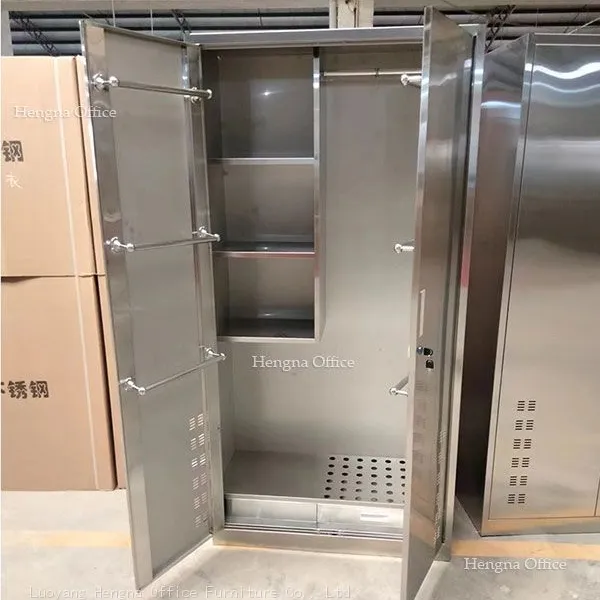
The ventilation on this cabinet is passive but deliberate. Two rows of slots on each side panel create a natural chimney effect. Warm, moist air exits through the top. Cooler, drier air enters from the bottom. Within a few hours of closing the doors, the interior humidity drops noticeably.
We tested this with a customer in a cold storage facility near Manchester. Their old cabinet (solid sides, no ventilation) had to be replaced every 18 months because the interior smelled like a wet dog. They switched to this ventilated version three years ago. The cabinet is still in service. The mops dry. The smell is gone.
Lockable — Not Optional When the Cabinet Is on the Floor
On a warehouse floor, the cleaning cabinet isn't in a locked room. It's accessible to fork lift drivers, pickers, packers, temp staff, and visitors. Getting a call from operations saying "someone got into the chemical cabinet" is a conversation you don't want to have.
The key lock on this cabinet is a steel cylinder lock with a solid bolt. It's not a privacy lock or a magnetic catch. It takes a key to open, and the bolt seats firmly into the strike plate. A warehouse worker leaning against the door won't pop it open.
If you run a facility with a master-key system, we can supply a padlock hasp version instead. Your lock, your key control.
Concrete-Ready Construction
Warehouse janitor closets have concrete floors. That means they're often damp, sometimes uneven, and always hard. The cabinet sits on adjustable leveling feet — not just cosmetic, but actual threaded feet that let you stabilize the cabinet on an uneven floor. No rocking. No doors that won't close because the floor slopes.
The bottom of the cabinet is reinforced to handle impact from floor scrubbers and carts that bump into it. The feet are stainless steel, so they don't rust where they contact the concrete.
Storage Layout: Designed for the Cleaning Workflow
A "Floor-First" Shelf Layout
The shelf spacing isn't random. We sat down with cleaning crews at a distribution center in the Midlands to understand how they actually use a janitor cabinet. Here's what we learned:
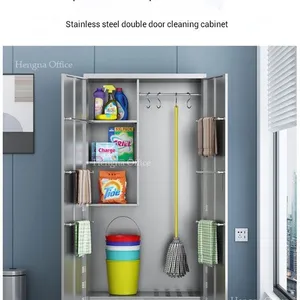
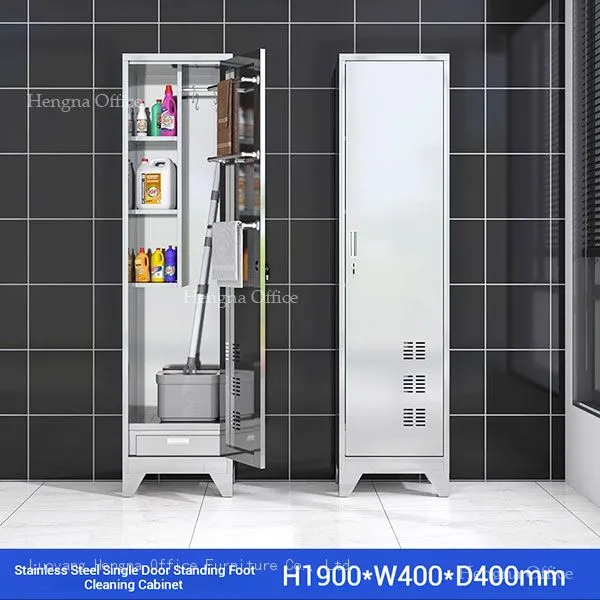
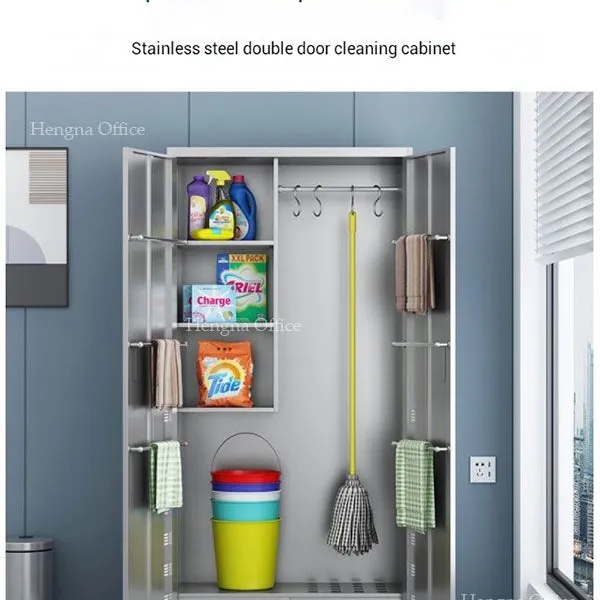
The top shelf should hold things that stay dry. Paper towels, gloves, clean rags. This shelf gets opened but doesn't get handled every time the cabinet is accessed.
The middle shelves are for the stuff that gets grabbed multiple times a day. Spray bottles, brushes, mop heads, small parts.
The bottom shelf is for heavy items. Five-gallon chemical buckets, floor stripper, wax. Things you don't want on an upper shelf because they're heavy and, if they leak, they drip through everything.
The shelves are adjustable in 25mm increments. If your warehouse uses taller containers, you can reconfigure the layout.
The Drying Rod: Where Wet Tools Actually Dry
Above the top shelf, there's a full-width stainless steel drying rod. This is where you hang wet mops after the floor is done. Not draped over the bucket, not leaning in a corner — hanging, with air circulating around the mop head.
A dry mop head lasts 2–3 times longer than one that stays damp between uses. In a busy warehouse where the cleaning crew does multiple passes per day, that adds up quickly.
Door-Back Hooks for Quick Access
Four steel hooks on the inside of the door are for the stuff you need without opening both doors — dustpans, brushes, spray bottles. Open one door, grab the item, close it. No rummaging through shelves.
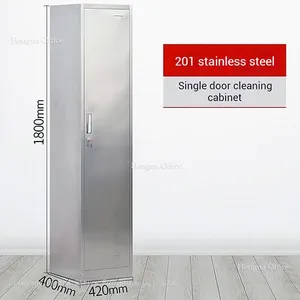
201 Stainless Steel: The Practical Choice for Warehouse Floors
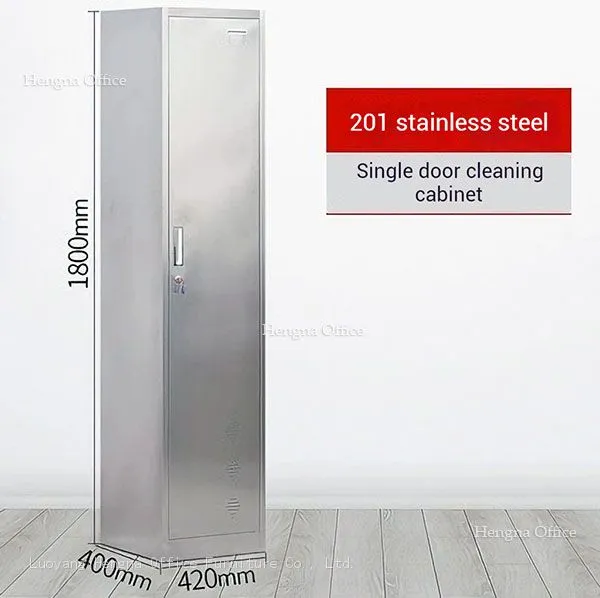
We sell this cabinet in both 201 and 304 stainless. For warehouse floor use, 201 is the practical choice in most cases. Here's why.
The environment on a warehouse floor is humid but not chemically aggressive. Cleaning chemicals are stored in sealed containers and don't routinely contact the steel surface. The main risk to the cabinet is condensation and general humidity — not acid splashes or salt spray.
201 stainless steel handles humidity well. It's the same alloy used in commercial kitchen applications (exhaust hoods, countertop splashbacks) where humidity is constant. It's strong — 150 kg per shelf capacity — and it costs significantly less than 304.
The exception is coastal warehouses. If your facility is within 3 km of the ocean, the salt air will attack 201 faster than 304. In that case, go with 304. Same for chemical storage rooms where undiluted cleaning chemicals might sit on the steel surface. Otherwise, 201 is the right call.
Drainage: The Feature That Keeps the Floor Dry
Warehouse cleaning produces dirty water. Mop buckets get emptied. Floor scrubbers dump waste water. Sometimes a container leaks.
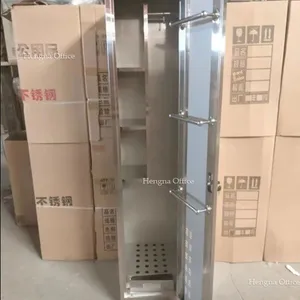
The bottom of this cabinet has a drain hole and a removable drip tray. Water doesn't pool on the cabinet floor — it drains through the hole and either goes into the drip tray or (if you position the cabinet over a floor drain) directly into the drain.
The drip tray lifts out for cleaning. Thirty seconds with a hose and it's clean.
A facilities manager in Rotterdam told us this was the feature that sold him. His warehouse janitor closet had a floor drain, but the old cabinet (no drainage) just trapped water inside. Every few months, the bottom shelf would start showing rust spots from standing water. With the drain hole, the water exits. The cabinet stays dry. The rust spots stopped appearing.
Dimensions: 20×16×71 Inches — Why These Numbers
| Dimension | Inches | mm | Why |
|---|---|---|---|
| Width | 20″ | 500 | Fits through standard doorways |
| Depth | 16″ | 400 | Narrow enough for tight closets |
| Height | 71″ | 1800 | Uses vertical space, reachable by most people |
The 16-inch depth is narrower than many janitor cabinets (which often run 20–24 inches deep). We chose 16 inches because warehouse janitor closets are frequently shared spaces — there might be a floor scrubber parked next to the cabinet, or a slop sink on the same wall. A shallower cabinet leaves room for the things that share the closet.
If you have a larger janitor closet, we make a 20-inch deep version. For most warehouse applications, 16 inches is the better fit.
Who This Cabinet Is For
This cabinet is for:
Manufacturing plant floors — where the cabinet sits near the production line cleaning station
Warehouse dock areas — where dust, dirt, and moisture are constant
Cold storage warehouses — where the cabinet handles temperature swings without warping
Food processing facilities — where 201 stainless meets food-safe requirements for non-contact storage
Auto parts distribution centers — where grease and cleaning solvents are part of daily operations
Any facility where the cleaning cabinet lives on the concrete floor, not in a carpeted hallway
If your facility matches one of these, this cabinet is spec'd for you. If not, tell us what you need — we'll help you pick the right model.
About Luoyang Hengna
We're Luoyang Hengna Office Furniture Co., Ltd., based in Luoyang, China. We've been manufacturing steel commercial and industrial furniture since 2017.
We're not a trading company. You're buying from the people who make the cabinet. That means:
We answer your questions directly
We handle modifications in-house
We give you real lead times, not guesses
We quote within 24 hours
Our cabinets are CE certified. We've shipped to facilities in 20+ countries. And we stand behind what we build.
FAQ: From People Who Actually Buy These
Q: How many cabinets for a 30,000 sq ft warehouse? A: Usually 2–3, depending on how many cleaning zones you have. One near the dock, one near the break area, one near the production floor. We've had customers put in 5 for a 50,000 sq ft facility — it depends on layout.
Q: Does the ventilation work in cold storage (2–5°C)? A: Yes. The passive airflow still moves. We have customers using this cabinet in chilled distribution centers. The steel handles the cold without issues. Standard locks also work fine in low temperatures. If you're going below -10°C, confirm with us — the lock grease thickens at very low temps.
Q: What if I need it in 304 stainless? A: Tell us at quote. 304 costs more, but for coastal facilities or heavy chemical storage, it's the right spec. We'll quote both so you can compare.
Q: Does it ship assembled? A: Ships KD (knocked down). Assembly takes about 45 minutes. The box is flat, so shipping costs are reasonable. If you need pre-assembled, tell us — we'll arrange it.
Q: Can I get a sample quote for 5 units to a UK warehouse? A: Yes, ship to a UK address. We'll need your postal code and delivery instructions. We'll reply within 24 hours with CIF pricing.
Q: Is this cabinet OSHA-compliant? A: For general cleaning supply storage, yes. For hazardous chemical storage that requires fire-rated cabinets, you need a different product. We can tell you which one if you tell us what you're storing.
One Sentence Summary
Industrial cleaning cabinet with real ventilation, proper lock, categorized storage, drain, and drying rod — built for warehouse floors, not office break rooms. 20×16×71 inches. 201 or 304 stainless. Ships from Luoyang. CE certified. Quote in 24 hours.

Send Inquiry to This Supplier



You May Also Like
-
Large-Capacity Cleaning Storage Cabinet | Cold-Rolled Steel, Modular Design | for Calgary, AlbertaUS$ 100 - 350MOQ: 5 Sets
-
OEM Manufacturer of Janitorial Cabinet|1800mmH x 850mmW x 390mmD| Waterproof Metal Clean Cabinet for Office BuildingUS$ 100 - 350MOQ: 5 Sets
-
Ventilated Cleaning Supply Storage Supplier in Regina|Rugged Staff Breakroom Metal Locker| for Industrial PlantsUS$ 100 - 350MOQ: 5 Sets
-
Professional Metal Janitorial Storage Cabinet Factory Direct | Durable Waterproof Mop and Broom Closet | for Office BuildingsUS$ 100 - 350MOQ: 5 Sets
-
Custom Quiet-Close Cleaning Supply Cabinet Maker in Mississauga | Silent Soft-Close Hinges & 3-Point Security Lock | HNJUNTUOUS$ 100 - 350MOQ: 5 Sets
-
Stainless Steel Janitorial Cabinet for Property Management — Lockable, With Mop Rack, Drain and Ventilation, 20×16×71 inUS$ 100 - 350MOQ: 5 Sets
-
14-Gauge Heavy Duty Custodial Locker in Stock in Hamilton | Impact Resistant & Chemical Guard Powder Coating | JUNTUOUS$ 100 - 350MOQ: 5 Sets
-
Marine Grade Anti-Rust Janitorial Cabinet| for Offshore Facilities in St. John's NL | 1000H Salt Spray Tested Corrosion Resistance | JUNTUOUS$ 100 - 350MOQ: 5 Sets
-
Waterproof & Rust-Resistant Commercial Janitorial Cabinet | With Adjustable Shelves and Ventilation Holes | for SchoolsUS$ 100 - 350MOQ: 5 Sets
-
Premium Weather-Proof Cleaning Supply Storage| Kelowna - Locking Metal Broom Closet |for Retirement HomesUS$ 100 - 350MOQ: 5 Sets


