Material
Other, Global universal model
Condition
Other, Global universal model
Task
Other, Global universal model
Mathematical Model
Other, Global universal model
Signal
Other, Global universal model
Customized
Non-Customized
Structure
Other, Global universal model
Operating temperature
-20℃ to 60℃
Humidity
0% - 95% (non-condensing)
I. Overview
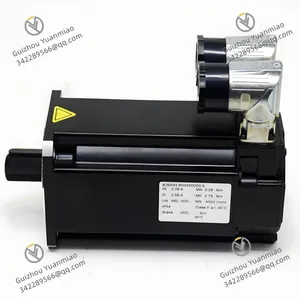
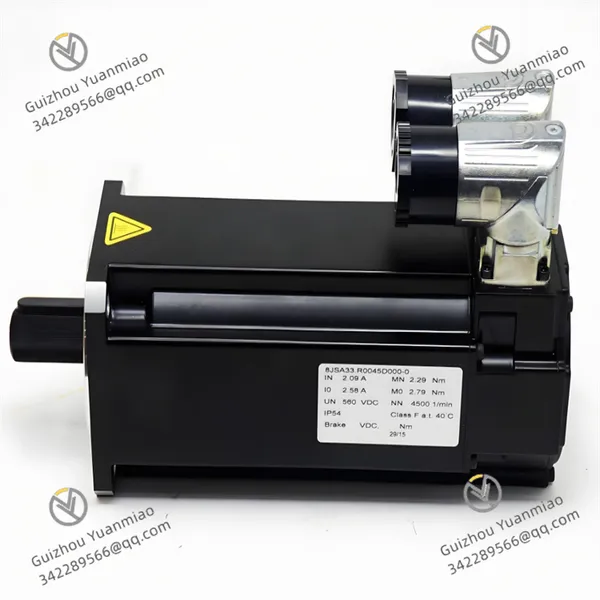
B&R 8JSA33.R0045D000-0, as a high-performance servo motor under B&R, occupies an extremely critical position in the process of industrial automation. With its profound technical heritage and accurate insight into industrial application scenarios, B&R has meticulously developed this product, enabling it to operate stably in complex and harsh industrial environments and provide reliable guarantee for precise motion control of various mechanical equipment.
In the broad field of industrial automation, from precision machine tool processing to efficient automated production lines and complex robot motion control, B&R 8JSA33.R0045D000-0 can play a significant role. It is mainly responsible for precisely controlling key parameters such as the motion trajectory, speed, and position of mechanical equipment, ensuring that each production link meets extremely high precision standards, thereby improving product quality and production efficiency.
II. Functional Features
High-Precision Motion Control
Position control accuracy: With its high-resolution encoder and advanced control algorithms, B&R 8JSA33.R0045D000-0 can achieve extremely high position control accuracy, precisely controlling the rotation angle of the motor and ensuring that the equipment positioning error is within a very small range. In precision machine tool processing, it can accurately control the position of the tool, processing parts that meet strict dimensional tolerance requirements, ensuring the consistency and reliability of product quality.
Speed control stability: It performs excellently in speed control, being able to maintain stable speed output under different load conditions. Through closed-loop control technology, it real-time monitors and adjusts the motor speed. Even in case of sudden load changes, it can quickly respond and return to the set speed, ensuring the smooth progress of the production process and improving production efficiency and product quality. For example, in automated production lines, it can stably drive the conveyor belt to ensure the consistency of product transportation speed.
Fast Response Characteristics
Dynamic response capability: The motor has excellent dynamic response capability and can quickly follow changes in control commands. The time required from a stationary state to reaching the rated speed is extremely short, and it can complete acceleration and deceleration actions in an instant. This feature is particularly important in equipment that requires frequent start-stop or rapid changes in motion state, such as packaging machinery, which can quickly complete material grabbing, handling, and packaging actions, improving production efficiency.
Command tracking performance: It can accurately track various complex motion commands, whether simple linear motion commands or complex curve interpolation motion commands, and execute them accurately. In robot motion control, it can quickly and accurately complete various complex actions according to preset programs, achieving efficient production operations.
High Reliability and Stability
High-quality materials and manufacturing processes: In hardware manufacturing, high-quality raw materials and advanced manufacturing processes are selected. The windings inside the motor use high-purity copper to reduce resistance and improve motor efficiency; the iron core uses high-quality silicon steel sheets to reduce hysteresis loss. At the same time, through precise manufacturing processes, the processing accuracy and assembly quality of various parts of the motor are ensured, guaranteeing the reliability and stability of the motor from the source.
Comprehensive protection mechanisms: It has built-in multiple protection functions, such as overcurrent protection, overvoltage protection, overheating protection, etc. When the motor has excessive current, abnormal voltage, or excessive temperature during operation, the protection mechanism will start immediately, automatically cut off the power supply or take corresponding protection measures to avoid damage to the motor due to faults, extend the motor service life, and reduce equipment downtime.
Good Compatibility and Expandability
Compatibility with B&R systems: As an important part of the B&R automation product system, B&R 8JSA33.R0045D000-0 has excellent compatibility with other B&R equipment, such as drives and controllers. It can seamlessly integrate with B&R's control systems, achieving efficient data interaction and collaborative work, reducing system integration difficulty and cost.
Compatibility with third-party equipment: It not only has good compatibility with B&R's own equipment but also can interconnect with many third-party equipment. It supports multiple general communication protocols, such as Modbus, Ethernet/IP, etc., which can conveniently communicate and collaborate with sensors, actuators, and upper computer systems of other brands, providing users with more choices and flexibility when building complex industrial automation systems.

III. Common Faults and Solutions
Motor not rotating
Fault phenomenon: After receiving the start command, the motor has no action, and the motor shaft remains stationary.
Fault causes: It may be a power supply fault, such as loose or broken power lines, causing the motor to fail to receive normal power supply; a drive fault, such as the drive not being initialized correctly or internal circuit damage, making it unable to output drive signals to the motor; a motor fault itself, such as winding short circuit, open circuit, or bearing seizure.
Solutions: First, check the power connection to ensure that the power lines are firmly connected, and use a multimeter to detect whether the power supply voltage is normal. If the power supply is normal, check the working status of the drive, check whether the drive's indicator lights are displayed normally, and try to re-initialize the drive. If the problem remains unresolved, the motor needs to be disassembled for inspection. Use professional instruments to detect the resistance value of the motor windings to determine whether there is a short circuit or open circuit. At the same time, check whether the bearing rotates flexibly, and if damaged, replace the corresponding parts in time.
Abnormal motor speed
Fault phenomenon: The actual motor speed does not match the set speed, and there may be situations such as excessively high, excessively low, or unstable speed.
Fault causes: It may be an error in the speed setting parameters, where the user entered the wrong value when setting the motor speed; an encoder fault, causing the speed signal fed back by the motor to the drive to be inaccurate, thus making the drive unable to correctly adjust the motor speed; improper drive parameter settings, such as unreasonable settings of speed loop gain, integral time, etc., affecting the motor's speed control performance.
Solutions: Carefully check the speed setting parameters to ensure they are consistent with actual needs. Use professional equipment to detect the working status of the encoder, check whether the pulse signal output by the encoder is normal, and if abnormal, replace the encoder. Readjust the speed control parameters of the drive, and optimize parameters such as speed loop gain and integral time according to the actual operation of the motor to achieve stable speed control effect.
Severe motor heating
Fault phenomenon: After the motor runs for a period of time, the temperature rises significantly, even exceeding the normal working temperature range, and may be accompanied by an unusual smell.
Fault causes: It may be that the motor is overloaded, bearing excessive load for a long time, causing the motor current to increase and heating to intensify; poor heat dissipation, such as damage to the motor's cooling fan or blockage of the ventilation port, affecting the motor's heat dissipation effect; internal motor faults, such as partial short circuit of the windings, leading to uneven current distribution and severe heating in some areas.
Solutions: Check whether the load carried by the motor is normal to avoid overloading. Clean the motor's cooling fan and ventilation port to ensure the heat dissipation channel is unobstructed. If a motor winding short circuit is suspected, use professional testing equipment to conduct a detailed inspection of the motor windings, and after determining the short circuit location, repair or replace the windings.