Application
Other, Global universal model
Brand
Other, ABB
Number of Stator
Other, Global universal model
Number of Poles
Other, Global universal model
Casing Protection
Other, Global universal model
Starting Mode
Other, Global universal model
Speed
Other, Global universal model
Operating Temperature
0°C to 55°C
Dimensions
150mm×100mm×50mm
Working Voltage
24V DC (±10%)
Overview
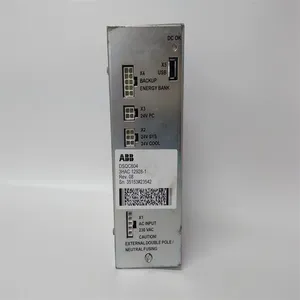
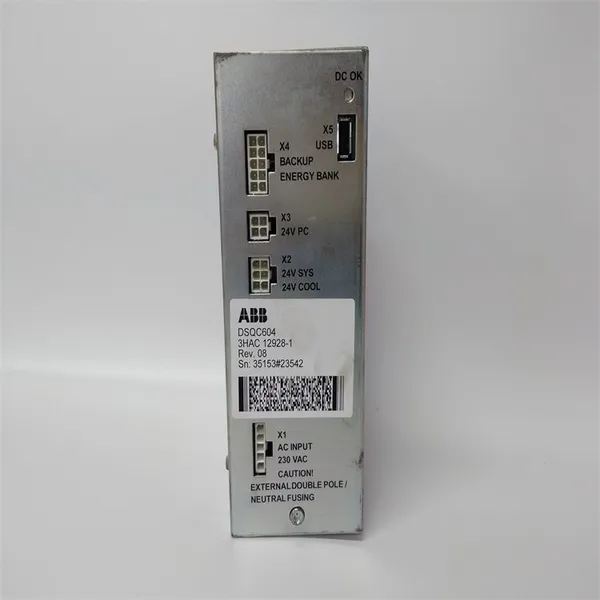
The ABB DSQC604 3HAC12928-1 is a compact multi-functional I/O (Input/Output) board specially designed for industrial robot applications, playing a key role in signal transmission and control in industrial automation production. As an important part of ABB's robot control system, it relies on ABB's deep accumulation and innovation capabilities in the field of robotics to achieve stable and efficient signal interaction and data transmission between industrial robots and external devices, helping to upgrade industrial production processes towards automation and intelligence. By precisely controlling the robot's motion execution and coordinating with peripheral devices, this module effectively improves the efficiency, precision, and reliability of industrial production.
Technical Parameters
| Parameter Category |
Details |
| Product Model |
DSQC604 3HAC12928-1 |
| Product Type |
Industrial Robot I/O Board |
| Digital Input Channels |
16 |
| Digital Output Channels |
16 |
| Input Signal Type |
24V DC |
| Output Signal Type |
24V DC |
| Maximum Output Current |
1A per channel, total output current 10A |
| Electrical Isolation |
All channels with electrical isolation, isolation voltage 500V AC |
| Communication Interface |
DeviceNet communication interface |
| Communication Rate |
125/250/500 kbps |
| Working Voltage |
24V DC (±10%) |
| Power Consumption |
Approximately 8W |
| Operating Temperature Range |
0°C to 55°C |
| Storage Temperature Range |
-20°C to 70°C |
| Protection Level |
IP20 |
| Dimensions |
150mm×100mm×50mm |
| Weight |
Approximately 0.3kg |
| Installation Method |
Standard 35mm DIN rail installation |

Functional FeaturesRich I/O Channel Configuration
With 16 digital input channels and 16 digital output channels, it can meet the diversified signal acquisition and control needs of industrial robots in complex production tasks. For example, in an automobile welding production line, it can simultaneously receive position detection signals from multiple sensors and output control signals to drive the start/stop of welding equipment and adjust welding parameters.
High-Speed and Stable Communication
Based on the DeviceNet communication protocol, it supports multiple communication rates of 125/250/500 kbps, ensuring fast and stable data transmission between the robot controller and external devices. Even on high-speed automated production lines, it enables real-time signal interaction to ensure precise matching between robot movements and production rhythms.
Reliable Electrical Isolation
All I/O channels have an electrical isolation capability of 500V AC, effectively isolating external electrical interference and preventing signal crosstalk and electrical faults from affecting the system. In industrial sites with complex electromagnetic environments, it significantly improves system stability and safety, avoiding robot misoperation or equipment damage caused by interference.
Flexible Signal Processing
It can preprocess input 24V DC digital signals through filtering, shaping, etc., to ensure input signal accuracy; output signals have strong driving capability, with each channel capable of outputting 1A current, directly driving common industrial executive components such as solenoid valves and relays, simplifying system wiring and configuration.
Convenient Installation and Maintenance
Adopting the standard 35mm DIN rail installation method, the installation process is simple and quick, and it can be easily integrated into industrial control cabinets. Meanwhile, the module is equipped with clear LED status indicator lights to display the working status of each channel in real time, facilitating operators to quickly troubleshoot faults and reducing maintenance difficulty and time costs.

Application FieldsAutomotive Manufacturing
Widely used in production links such as automobile body welding, painting, and final assembly. By connecting welding robots, painting robots, handling robots, etc., it realizes precise control of robot movements and collaborative operations with peripheral devices such as fixtures and conveyor lines. For example, it controls the welding robot to complete welding at preset points while coordinating the fixture to clamp workpieces, ensuring efficient automobile production and stable quality.
Electronics Manufacturing
Suitable for processes such as electronic product assembly and testing. In production lines for mobile phones, computers, and other electronic products, it controls robots to complete fine operations such as component picking, mounting, and welding, and cooperates with visual inspection equipment to achieve real-time product quality monitoring and feedback. For instance, it drives the robot to accurately mount chips onto specified positions on circuit boards and adjusts mounting parameters based on inspection results.
Machinery Processing Industry
Used in automated scenarios such as CNC machine tool loading/unloading and part handling. The DSQC604 3HAC12928-1 module controls the robot to accurately grasp processed parts and place them in specified positions, while interacting with the machine tool control system to achieve automated connection of the processing flow, improving the production efficiency and automation level of mechanical processing.
Food and Packaging Industry
Plays an important role in food sorting and packaging production lines. It controls robots to complete operations such as food grabbing, sorting, and boxing, and coordinates with packaging equipment to realize automated packaging processes. For example, according to product types and packaging requirements, it controls the robot to accurately place food of different specifications into packaging boxes and starts sealing equipment to complete packaging.
Logistics and Warehousing Field
Applied to goods handling and palletizing operations in automated warehouses. By communicating with equipment such as stackers and conveyor belts, it controls robots to efficiently complete goods storage and palletizing tasks. According to instructions from the warehouse management system, the robot precisely grabs goods and transports/palletizes them along planned paths, enhancing the automation and intelligence of warehousing logistics.