Material
Other, Global universal model
Condition
Other, Global universal model
Task
Other, Global universal model
Mathematical Model
Other, Global universal model
Signal
Other, Global universal model
Customized
Non-Customized
Structure
Other, Global universal model
FOXBORO P0916PH
Main Features
High-Precision Measurement: The module features high measurement accuracy, accurately reflecting the true value of the measured voltage.
Multiple Input Signals: Supports various input signal types, such as AC/DC voltage and current, with strong adaptability.
Multiple Output Signals: Provides various output signals, such as analog and digital outputs, facilitating connection with other devices.
High Reliability: Adopts high-reliability electronic components and design, enabling stable operation in harsh industrial environments.
Easy Installation and Maintenance: The module has a simple structure, convenient installation, and low maintenance costs.
Functional Purpose
Mainly used for voltage monitoring with a range of 0-1000V. It can collect voltage data and transmit it to the host computer for data analysis and processing, and also provides protection against overvoltage and undervoltage.
FOXBORO P0916JS
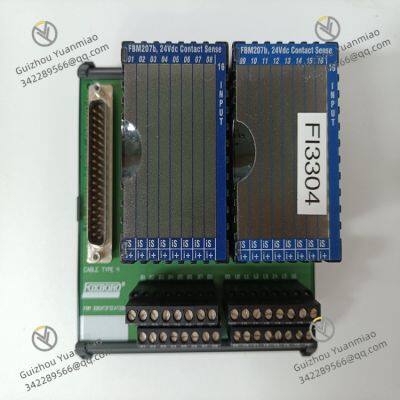
It is a terminal block module in the Foxboro I/A Series system, specifically the FBM207B terminal block designed for 24V DC-powered contact sensors.
Functional Purpose
As an interface between contact sensors and the control system, it is used for collecting and processing sensor data. It provides safe and reliable connections for sensors to ensure accurate and consistent data transmission. It may also have functions such as signal conditioning and isolation to further improve the accuracy and reliability of sensor data.
Application Scenarios
Typically used in industrial applications with contact sensors, such as manufacturing, process control, and automation systems. It is renowned for its robust structure and ability to withstand harsh industrial environments.

Working Principles of FOXBORO P0916PH and P0916JSSignal Transmission and Connection Principle
Electrical Interaction with Modules
The terminal assembly directly adapts to specific Foxboro modules (such as FBM series discrete input/output modules), docking with the module's signal pins through the back interface.
Electrical signals (such as digital and analog quantities) output by the module are transmitted to external terminals through the internal conductive structure (such as metal terminal blocks) of the terminal assembly, or external signals are introduced into the module conversely.
Wire Connection and Conductive Mechanism
Compression, screw, or spring connection methods (designs may vary by model) are adopted to ensure reliable contact between wires and terminals. For example:
Compression Connection: The wire is pressed tightly inside the terminal by mechanical pressure to reduce contact resistance, suitable for copper wires of specific gauges (such as 24-gauge).
Screw Connection: The wire is fixed by tightening screws, suitable for scenarios requiring frequent disassembly and assembly.
The internal conductive material of the terminal is usually copper or copper alloy, and the surface may be nickel-plated, silver-plated, etc., to reduce oxidation and contact resistance and ensure stable signal transmission.
Electrical Isolation Principle
If P0916PH/JS has isolation functions (such as optocoupler isolation, transformer isolation), the working principles are as follows:
Signal Transmission of Isolation Devices
Optocoupler Isolation: Achieves electro-optical-electrical conversion through a light-emitting diode (LED) and a photosensitive transistor (or thyristor), disconnecting the electrical connection between the module side and the external circuit, and transmitting signals only through light to prevent current interference between the two sides.
Transformer Isolation: Utilizes the principle of electromagnetic induction to transmit AC signals through transformer windings, isolating DC components, suitable for AC signal transmission scenarios.
Core Role of Isolation
Prevents surges, ground loop interference, etc., in external circuits from affecting the normal operation of the module and avoids module damage;
Avoids signal crosstalk between multiple channels to ensure independent operation of each channel.
Protection Function Principle
The terminal assembly may integrate protection mechanisms such as overcurrent, short-circuit, and overload, with the following principles:
Overcurrent/Short-Circuit Protection
Through built-in fuses, current-limiting resistors, or electronic protection circuits (such as PTC thermistors, MOSFET current limiting), when the external circuit current exceeds the rated value (such as 2A) or a short circuit occurs, the protection devices automatically cut off the circuit or limit the current to prevent damage to the module and load.
Some models have a self-recovery function (such as PTC resistors), which can automatically resume conduction after the fault is eliminated.
Overvoltage Protection
May integrate components such as TVS diodes and varistors. When the input voltage exceeds the rated range (such as 60V DC), the protection components quickly conduct to release the overvoltage, avoiding high voltage breakdown of the module or load.
Differentiated Principles of Different Models
| Model | Possible Functional Differences | Working Principle Characteristics |
|---|
| P0916PH | Possibly a high-voltage isolation terminal | Adopts enhanced isolation devices (such as high-voltage optocouplers) with a higher isolation voltage rating (such as 2500V AC), suitable for high-voltage industrial environments. |
| P0916JS | Possibly a multiplexed or high-speed signal terminal | Optimizes the internal conductive structure to support high-frequency signal transmission (such as PWM signals) or integrates multi-channel parallel transmission to reduce signal delay. |