








 Contact Platform Support
 Help Center
Screws vs



Related Products
ls? And sometimes there's no consensus.
Is there a case where nails are better than screws, from a structural standpoint? For instance: Say you used screws instead of nails on a backyard deck, when the design specifically called for nails. Would the result be inferior? Could it fail inspection? Would nails absolutely be preferable in this instance? Are there any rules of thumb about when to use screws vs. nails?
Screws are a "superior" fastener over a nail (they have far superior tensile strength)—especially if you're talking about screwing down decking. However there are many scenarios where a nail is the proper fastener for the application (attaching joists is one example—screws are brittle and will fail when subjected to the forces of a shear loaded application).
Using your deck example—you should use nails to attach the joists to the deck framing but use screws to fasten down the decking itself.
Nails are used in almost all framing and structural applications. Most code books are designed with nails in mind and will have specific minimum nailing requirements and patterns for different applications.
Structural screws are coming more and more on the market every day, but because most code books don't include them you will need an engineer's approval of their use to pass inspection in many cases. If you want to use structural screws without paying the big $$ for an engineer you should talk with your municipal build dept. first to see if they will allow it.
Your normal wood screws are not structural. Standard screws are brittle. If you take a normal screw and drive it part way in and whack it with a hammer, it will snap. If you do this with a nail, the nail will bend. Which would you rather have holding your deck up? Something that bends but stays intact or something that can snap?
In the end: nails, hex bolts, and lag bolts are still better in most applications. Structural screws are just easier than bolting and cooler than nailing.
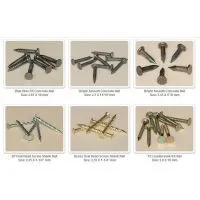
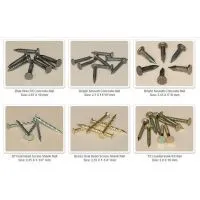
8. Hardware Nails, Roofing nails, Box Nail, hot-dipped galvanized smooth nails
Hardware nails from KRS can help your business in virtually any of your fastening jobs. Find the variety of common nail you want in an array of sizes, gauges and finishes to suit your project's needs. Roofing nails are available for roofing and sheathing in a variety of quantities and lengths from 1 to 2 inches. Or select a brad nail to hang paneling, or install baseboards, door trim and window trim. Grainger nails your needs for hardware nails.
Box Nail, Steel, Hot Galvanized Finish, Head Type Flat, Shank Type Smooth, 6d Size, 17/64 In Head Dia, 12 1/2 Gauge, 0.099 In Dia, 2 In Length, Package Weight 1 Lb, Package 236
2-Gauge 6-in Hot-Dipped Galvanized Smooth Nails
Most popular nail and versatile style
For construction, carpentry and framing
Larger shank for more strength
Flat head and diamond point
Galvanized for limited resistance to rust

Send Inquiry to This Supplier

You May Also Like
-
 Reliable HDPE Plastic Concrete Nail for Insulation, Safe and Secure FasteningUS$ 0.02 - 0.08MOQ: 1000 Pieces
 -
Professional Grade Collated Fasteners Plastic Strip White Zinc, 25mm/35mm/40mm, Free Samples and Factory Wholesale Price for Metal StudsUS$ 0.01 - 0.1MOQ: 1000 Pieces
-
Metal Construction NailsNegotiableMOQ: 2300 Pieces
-
16G/18G Brad Nails China Factory With Zinc Plating for Corrosion ResistanceNegotiableMOQ: 5 Tons
-
Fit R175-C Roofing Coil Nailer Roofing NailsUS$ 15 - 32MOQ: 100 Cartons
-
Wholesale Flat Head Stainless Steel Nail Drive Screw NailsUS$ 0.001 - 0.02MOQ: 10000 Pieces
-
Hard Copper Clout Nails Copper NailUS$ 0.0001 - 0.1MOQ: 50000 Pieces
-
Insta Hang ,nail With Hooks Kit,pegsUS$ 2 - 4MOQ: 3000 Sets
-
THUMB TACKSNegotiableMOQ: 10000 Boxes
-
All Kinds of Standard Black Concrete Nail Concrete Steel NailUS$ 456 - 465MOQ: 1 Ton


