








 Contact Platform Support
 Help Center
Home > Chemicals > Fertilizer > Potassium Fertilizer > Mineral Natural Organic Fertilizer, Humic Potassium Humate 60%
Mineral Natural Organic Fertilizer, Humic Potassium Humate 60%
US$ 300 - 1,000
MOQ: 5 Metric Tons
Key Specifications
Get Latest Price
Type:
Potassium Humate
CAS No.:
68514-28-3
Other Names:
Humic Acid Potassium Salt
Payment & Shipping
Payment Methods:


Port of Shipment:
Qingdao Tianjin Shanghai
Delivery Detail:
Delivery time depends on order quantity.
Related Products
-
 100% Water Soluble Water Flush Fertilizer, Humic Acid Potassium Humate PowderUS$ 300 - 2,000MOQ: 5 Metric Tons
 -
Soluble Organic Fertilizer Natural Potassium HumateUS$ 1 - 500MOQ: 1 Metric Ton
-
Korean Customers Like Black Shiny Flake State Potassium HumateUS$ 500 - 1,500MOQ: 5 Metric Tons
-
Providing Potassium Humate To Distributors In PakistanUS$ 300 - 2,000MOQ: 5 Metric Tons
-
Super Refined Potassium Humate FertilizerUS$ 1 - 1,500MOQ: 1 Metric Ton
Type
Potassium Humate
CAS No.
68514-28-3
Other Names
Humic Acid Potassium Salt
MF
C9H8K2O4
EINECS No.
270-030-1
Place of Origin
Xinjiang, China
Release Type
Quick
Purity
98%
Application
Agriculture, Foliar Spray, Base Fertilizer
Brand Name
CXKJ
Model Number
CXKJ-002
Mineral Natural Organic Fertilizer, Humic Potassium Humate 60%
Defination
Potassium humate is ideally suited for addition with fertilizers, such as Urea. With prominent effect to release the locked phosphate
by some ions such as Fe3+, Al3+, also can slow-release nitrogen fertilizer to promote the function of NPK fertilizers.
Description
| Name | Potassium Humate |
| Brand Name | CXKJ |
| Model Number | CXKJ-002 |
| Molecular Formula | C9H8K2O4 |
| CAS | 68514-28-3 |
| EINECS | 271-030-1 |
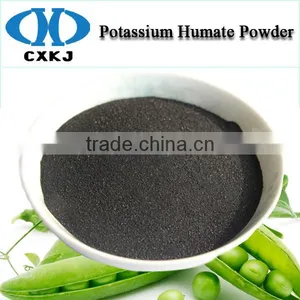
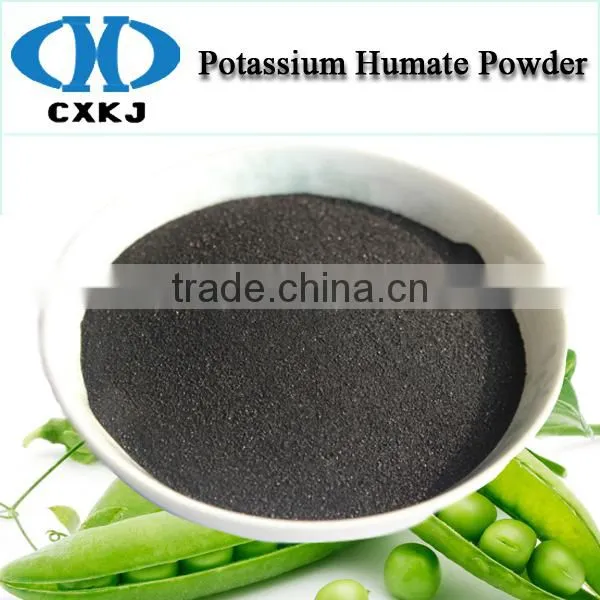
| Appearance | Black Powder |
| Water Solubility | 80% |
| Humic Acid (dry basis) | 60% min |
| K2O | 8% / 10% / 12% min |
| PH | 9.0-11.0 |
| Moisture | 18% max |
| Purity | 98% |
| Nitrogen | 0.35% |
| P2O5 | 0.02% |
| Fe | 0.10% |
| Mesh | 60 |
| Sieve Residues (0.5mm) | 5% max |
| Application | Agriculture & Industry |
| Dosage | Foliar Spray Fertilizer: 0.5-1kg per unit area |
| Irrigation Fertilizer: 1-2 kgs per unit area | |
| Pay attention to | Concentrations will vary depending on the needs of the crop |
| or soil, the micro-climate, the soil type and desired results. | |
| Other State | Crystal, Granule & Flakes |
| Caution | Pls keep in sealed & damp proof place. |
Functions
Physical Benefits:
- Increases water holding capacity
- Increase soil aeration
- Improve soil workability, making it more friable and crumbly
- Improve drought resistibility
- Improve the seedbed
- Reduce soil erosion
Chemical Benefits:
- Retain water-soluble inorganic fertilisers in the root zones and release them to plants when needed
- Promote the conversion of a number of elements into bioavailable forms to plants
- Provide extremely high ion-exchange capacities
- Participate in the decomposition of rocks and minerals
- Increase the buffering properties of soil
- Chelate metal ions under alkaline conditions
- Provide rich organic and mineral substances essential to plant growth
- Increase nitrogen content in soil
Biological Benefits:
- Stimulates plant growth by accelerating cell division, increasing root system development, and increasing yield of dry matter
- Strengthens root system development, respiration and growth for quicker and improved mineral and nutrient intake
- Increase germination and viability of seed
- Increase vitamin content of plants
- Increase plant membrane permeability to optimise mineral intake
- Increase plasma permeability to optimise nutrient intake
- Act as a supplementary source of polyphenols which are respiratory catalysts
- Converts heavy metals (e.g. iron) into bioavailable forms to protect plants from chlorosis
- Stimulates plant growth by accelerating cell division
- Stimulates plant enzymes
- Supports plant photosynthesis
Uses
Base fertilizer: 5-10kg per hactare with 100kg urea.
Also it depens on the soil condition.
Irrigation: 5-8 kg/ha.
Pictures
Welcom to visit our factory!

Send Inquiry to This Supplier

Business Type
Manufacturer, Trading Company
Year Established
2002
Factory Size
5,000-10,000 square meters
Total Employees
301 - 500 People
You May Also Like
-
Potassium FertilizerNegotiableMOQ: 2300 Kilograms
-
Mineral Supplement FA PotassiumUS$ 1,000 - 1,500MOQ: 1 Ton
-
Granular Humate Acid FertilizerUS$ 450 - 1,000MOQ: 5 Tons
-
Foliar Fertilizer Phosphite K Fosfito de Potássio Liquid 520g/L Liquid Spray FertilizerUS$ 1500 - 1700MOQ: 1 Metric Ton
-
Potassium NitrateNegotiableMOQ: 120000 Metric Tons
-
Potassium Sulphate White Powder Potassium Fertilizer K2O 52%MinUS$ 220 - 700MOQ: 5 Metric Tons
-
Magnesium Thiosulfate SolutionNegotiableMOQ: 1 Ton
-
Mannheim Process Potassium Sulphate (K2SO4) Making Equipments & TechnologyUS$ 1000000 - 1500000MOQ: 1 Set
-
13-0-46 KNO3 Fertilizer Grade 99.4% Potassium NitrateUS$ 699 - 999MOQ: 25 Tons
-
Professional High Water Solubility With Low PriceUS$ 615 - 685MOQ: 24 Tons


