








 Contact Platform Support
 Help Center
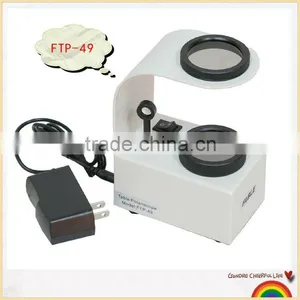
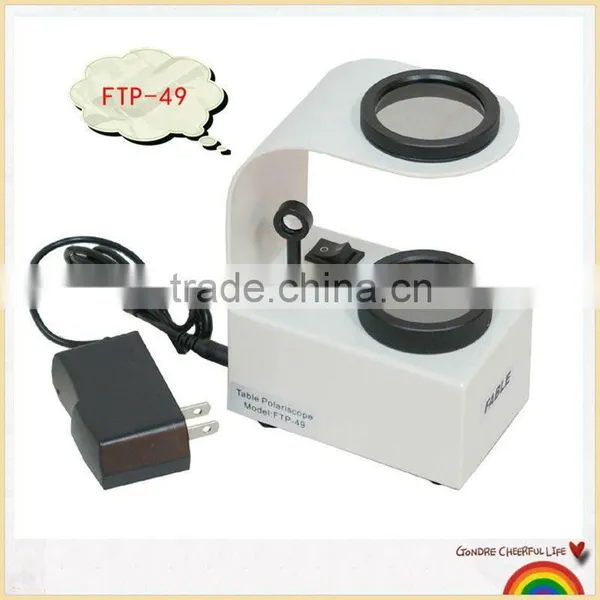
Desktop Polariscope Jewelry Instrument

Related Products
-
 Portable Professional Gem Polariscope Buit-in DC3V Button Battery For Distinguishing Homogeneous and Heterogeneous GemsNegotiableMOQ: 1 Set
 -
Mini PolariscopeNegotiableMOQ: 50 Pieces
-
Fable Table Prosessional Gem Polariscope FTP-49 With Conoscope and With 49mm Heavy CalibreNegotiableMOQ: 10 Sets
-
Portable Gem PolariscopeNegotiableMOQ: 10 Sets
-
LED Desktop PolariscopeNegotiableMOQ: 5 Sets
Specifications
Desktop Polariscope jewelry equipmentPolarizing filter diameter: 49mm
With rotatable sample platform.
CE certificate
Desktop Polariscope Jewelry Instrument
Polariscope Description:
Shows if a stone is doubly or singly refractive through a pair of polarized lenses encased in a sturdy plastic frame. Includes LED light source that attaches beneath the polariscope and protective carrying case.
1. Polariscope with 49mm heavy calibre.
2. With rotatable sample platform.
3. With white long life LED cold light source.
4. Accompany with a AC adapter, the power supply can also be two AAA type batteries
| Table Top Polariscope Instructions | ||
| A polariscope is used to differentiate between singly (isotropic) and doubly refractive (anisotropic) stones. A stone is placed between two polarizing filters and the top filter is then turned. If used with a conoscope, interference figures can also be seen with a polariscope. (Conoscopes are difficult to explain on paper, so directions for use are not covered here. We suggest you consult . They have videos showing the use of the conoscope. ) | ||
| 1 | Turn on | Attach power cord and plug in the polariscope. On/off switch at the back of the polariscope. |
| 2 | Place stone | Gently place stone on removable lense. Some people prefer to use tweezers to hold the stone between the two filters. We find this requires 3 hands, and simply rest the stone on the removable lense. |
| 3 | Rotating Lense |
Turn on polariscope. Look through the upper lense of the polariscope. Rotate the top lens until it is in the crossed position (dark.) Rotate removable lense exactly 1 full rotation. Results:
|
| 4 | Double Refraction Confirmation Test |
Return the polariscope to the dark (crossed filter position.) Use the stone holder to turn the stone to its lightest position. Then looking down through the top filter, quickly turn the top filter 1/4 turn. Results:
|
| Determining Refraction |
| Understanding your results: |
| Isotropic (single refractive or SR)-stays dark throughout a 360° rotation. |
| Anisotropic (double refractive or DR)-blinks 4 times,2 light and 2 dark during a 360° rotation . |
| Aggregate (AGG)-stays light throughout a 360° rotation |
|
Anomalous Double Refraction (ADR) -twinkles instead of blinks. Looks like double refractive but is single refractive. ADR is when a stone looks like it might be blinking, but really is just showing lighter where the stone is thinner or where there is a veil or weakness in the stone. Garnet and diamond sometimes display this phenomena. Tips! Be careful with using the polariscope for red / purple / orange stones. They often give confusing ADR results. Use your dicroscope or refractometer to confirm. Stones with very high RI's can also give misleading results. |
Isotropic |
Anisotropic Zircon |

Send Inquiry to This Supplier
You May Also Like
-
Metal Engraving MachineryNegotiableMOQ: 2700 Sets
-
Jewelry Tools Equipment GoldsmithNegotiableMOQ: 50 Pieces
-
2014 Best Sale ! Pneumatic Marking Machine for Stainless With CE Made in ChinaUS$ 900 - 2,000MOQ: 1 Set
-
Universal Paint Finished Die-cast Metal Body Tool HolderUS$ 1 - 30MOQ: 600 Pieces
-
Cnc Jade and Stone Carving Router DT0404SUS$ 3,500 - 7,000MOQ: 1 Set
-
Clever ClaspNegotiableMOQ: 2000 Sets
-
Wedding Bride Luxury Lane They Claw Drilling Beaded Dress Marriage Gauze Skirt Garment AccessoriesUS$ 1 - 4MOQ: 12 Pieces
-
CNC Laser Engraver/Cutting MachineUS$ 8 - 10MOQ: 1 Piece
-
HEFEI Suda Engraver/engraving MachineCNC CUTTER CHASING MACHINENegotiableMOQ: 1 Set
-
New Design Ladies Finger Ring Finger Ring Sizer Gauge Jeweler Jewelry Size Tool 3-13US$ 1 - 100MOQ: 100 Pieces


