








 Contact Platform Support
 Help Center
White-leg Shrimp Larva Farming RAS


Related Products
-
 RAS/Recirculation Aquaculture System Layout Design/indoor Fish Farming DesignNegotiableMOQ: 1 Set
 -
Intensive Recirculating Aquaculture Systems (RAS)/Indoor Fish FarmNegotiableMOQ: 1 Piece
-
Seawater RAS/Recirculating Aquaculture System Layout for Tilapia Fish FarmingNegotiableMOQ: 1 Piece
-
Intensive Recirculating Aquaculture Systems Grouper Farming RASNegotiableMOQ: 1 Piece
-
Intensive Recirculating Aquaculture Systems Sturgeon Farming RASNegotiableMOQ: 1 Piece
RAS offers the advantage that temperature and other variables can be controlled, in order to maximise growth and maintain fish health. Recirculating systems also require much less incoming water, some newer plants require only approx. 1 – 5%, compared to flow through farms, minimising the discharge to the environment and allowing operations to be established even where water supplies are quite small.
Often it is necessary for several of these components to be combined (i.e. biofilter, carbon dioxide degasser, nitrate filter and foam fractionation) for simplicity and capital savings. The resulting system is however generally compromised.
There are many ways to build a RAS system and no “one way” can be said to be best across all species, budgets and situations. eWater provide the best system for a particular application based on:
- Proven commercial production performance
- Capital cost (feasible within the funds available)
- Operational cost
- Reliability
- Availability of backup and technical advice
- Durability (useful lifetime of equipment)
- Ease of associated support activities (maintenance, feeding, grading, harvesting)
- Suitability for species cultured
- Technology that fits technical ability
- Redundancy/backup/unitisation so plant can continue to operate if there is an issue with part of it
- Flexibility to make changes as required without compromising production
- Expertise and experience of the operator
| White-leg Shrimp Larva farming RAS |
|
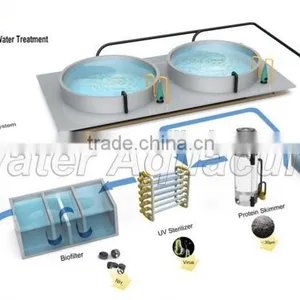
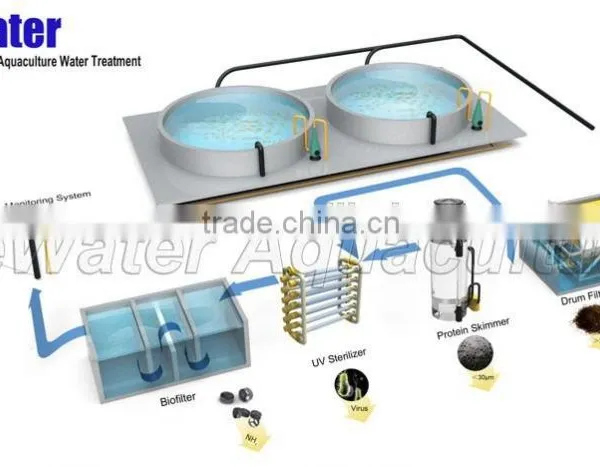
1 Functional Description 1.1 Design reference - indoor farming - salt-water farming - water volume 100 m3 1.2 Equipment - rotary drum filter - protein skimmer - UV sterilizer - bio-filter - oxygenation system (speece cone) - pump - controlling box - water quality monitoring system (optioanl) - heat pump (optional) - tank (optional) 1.3 Rendering |
| 2 Applications 2.1 white leg shrimp industrial farming, standard RAS for 150 m3 water volume 2.2 suitable for either sea-water farming or artificial seawater which is blended by freshwater (river-water, lake-water, or well-water) and artificial sea salt |
| 3 Advantages 3.1 Utilizing aquaculture water cyclically, improving energy/oxygen efficiency with minimum water wastes. 3.2 Preventing fish disease sources effectively, and providing control of cultural conditions (including water quality, water temperature, and water treatment processes). 3.3 High culture aquaculture density. 3.3 Experienced design with successful practices. 3.4 High quality, and still reasonable cost. |

Send Inquiry to This Supplier

You May Also Like
-
Fishery MachineryNegotiableMOQ: 2500 Sets
-
Livestock Mat Horse Stall Cow Puzzle MatUS$ 13.5 - 35.4MOQ: 100 Pieces
-
FRP Pole/ Sea Farming Pole for Nori FarmingUS$ 1 - 100MOQ: 2000 Pieces
-
4 Wheel Farm Trailer 4ton Tipping TrailerUS$ 1,300 - 3,800MOQ: 1 Set
-
Portable Bag CloserUS$ 75 - 80MOQ: 100 Sets
-
Iron Hose CollarNegotiableMOQ: 1 Piece
-
Adjustable Pintle HookNegotiableMOQ: 1 Unit
-
BF-A04 Series Fiber BasinNegotiableMOQ: 1 Piece
-
BQS Type Underwater AeratorNegotiableMOQ: 1 Set
-
Prawn Pond AeratorUS$ 200 - 200MOQ: 1 Set


