

The worldwide aviation sector is a technical, innovative, and exacting marvel that relies on some of the most modern aircraft makers in the world. These top-notch manufacturers not only construct airplanes but also lead the way in technology, sustainability, and design, thus influencing the manner and the place of traveling and shipping goods all over the planet. The following presentation reveals the ten most significant aircraft manufacturers and gives a full account of their participation in the industry’s history, their technical progress, and their global market impact. If you are an aviation lover, an industry insider, or just someone curious about the companies that make the airplanes we see in the sky, this article will grant you precious insights into the creativity and know-how that drive present-day aviation. Be prepared to uncover the innovations and the past of these firms as we invite you to a detailed and informative tour through the core of the aviation world.
1Boeing

1916
Introduction
The Boeing Corporation of the United States is the principal international provider of aerospace platforms and the largest commercial freight carrier, along with defense, space, and security systems.
Main Products
737 MAX, 747, 787 Dreamliner, and military aircraft like the F-15 and F/A-18.
Advantages
Leading-edge technology, a wide product array, and well-placed in both the commercial and military sectors.
Disadvantages
Recent events involving the Boeing 737 MAX product have tarnished the name of the company and created operational challenges.
2Airbus

1970
Introduction
Airbus is the primary competitor to Boeing and is the leading aerospace company in Europe.
Main Products
A320 family, A330neo, A350 XWB, A380, and, for the military, the A400M.
Advantages
One big name in the industry for its fuel-efficient air frames, state-of-the-art avionics, passenger-oriented, and top-notch, comfortable cabins.
Disadvantages
High operational complexity due to multi-national structures may lead to a decreased speed of decision-making.
3Lockheed Martin

1995 (Merger between Lockheed Corporation and Martin Marietta)
Introduction
Lockheed Martin sits atop the defense industry with distinction, encompassing military aircraft, space-related systems, and security technologies.
Main Products
F-22 Raptor, F-35 Lightning II, C-130 Hercules, and advanced satellite systems.
Advantages
Advanced technology in the military and a strong association with the government.
Disadvantages
Heavy reliance on defense contracts grants them only limited flexibility to adjust to government appropriation changes.
4Northrop Grumman

1939
Introduction
The Northrop Grumman Corporation is a principal contractor in military aviation and system provision, renowned for its innovative work in stealth technology.
Main Products
B-2 Spirit, E-2 Hawkeye, the RQ-4 Global Hawk, and exclusive autonomous systems.
Advantages
The leader in unmanned systems and advanced aircraft for tactical defense.
Disadvantages
The inability to diversify the lesser-known commercial aviation sector.
5Raytheon Technologies
2020 (Following the merger of Raytheon Company and United Technologies Corporation)
Introduction
In Aerospace Technology, Raytheon Technologies Company has a focus on defense-technology innovation, aircraft engines, and avionics in relation.
Key Products
This was quoted as Pratt & Whitney engines, Collins Aerospace, and missile systems.
Advantages
Diversification-based product portfolio and great for tackling all kinds of operations related to aviation and defense markets.
Disadvantages
Potential post-merger restructurings could hamper immediate efficiency gains.
6Bombardier

1942
Introduction
Bombardier, a Canadian manufacturer mainly engaged in business jets and previously having a renowned presence in the regional aircraft sector.
Main Products
Business jets from the Global and Challenger series.
Advantages
High-end luxury jets and long-standing respect in the corporate aviation industry.
Disadvantages
With the sale of its commercial aircraft division to Airbus, its product line is very limited.
7Embraer
1969
Introduction
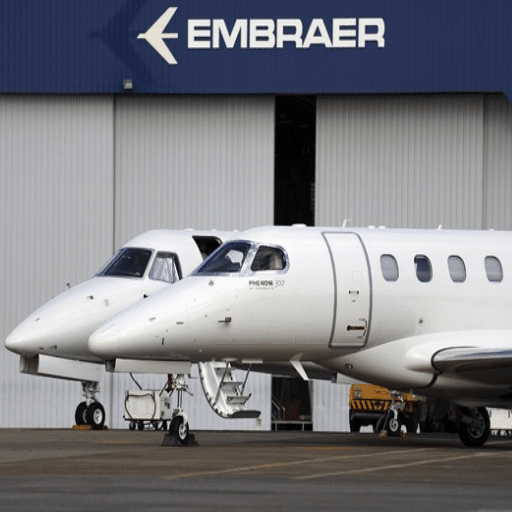
Embraer, as the Brazilian disbanded aircraft maker, is known for austere region-flying airliners and business planes.
Main Products
E-Jets E2 family, Phenom, and Praetor executive jets.
Advantages
Cost-effective aircraft with operational flexibility, with a great regional market ride.
Disadvantages
Small compared to the industry giants like Boeing and Airbus.
8General Dynamics (Gulfstream Aerospace)

1958 (Gulfstream acquired by General Dynamics in 1999)
Introduction
Gulfstream Aerospace industry leader in business aviation and is owned by General Dynamics.
Main Products
Gulfstream; G500, G600, G650, and G700 series.
Advantages
Out-performing business jets in terms of highest speed, highest range, and luxury features.
Disadvantages
High production costs constrain antibodies into the broad market.
9Textron Aviation
2014 (when acquired Beechcraft, Cessna, and Hawker models, all under Textron)
Introduction
Textron Aviation makes small airplanes and groundbreaking corporate jets.
Main Products
Cessna Citation jets, Beechcraft King Air, and Textron turboprops.
Advantages
Flexibility in creating light aircraft, paired with an enviable brand value in the private aviation market.
Disadvantages
It has no exposure to larger commercial or military markets.
10Sukhoi (United Aircraft Corporation)

1939
Introduction
Sukhoi belongs to the United Aircraft Corporation and is a well-known Russian aircraft manufacturing company that manufactures high-end military and civil aircraft.
Main Products
The Su-57 fighter jet, the Su-35, and the SSJ100 regional aircraft.
Advantages
Advanced aerodynamics and robust designs primarily for military applications.
Disadvantages
A geopolitical problem and competition prevented global marketing.
Quick Comparison Table
| Rank | Manufacturer | Founded | Specialization | Website |
|---|---|---|---|---|
| 1 | Boeing | 1916 | Commercial & Military | boeing.com |
| 2 | Airbus | 1970 | Commercial & Military | airbus.com |
| 3 | Lockheed Martin | 1995 | Defense & Space | lockheedmartin.com |
| 4 | Northrop Grumman | 1939 | Military & Stealth | northropgrumman.com |
| 5 | Raytheon Technologies | 2020 | Engines & Defense | rtx.com |
| 6 | Bombardier | 1942 | Business Jets | bombardier.com |
| 7 | Embraer | 1969 | Regional & Business | embraer.com |
| 8 | General Dynamics (Gulfstream) | 1958 | Luxury Business Jets | gulfstream.com |
| 9 | Textron Aviation | 2014 | Light Aircraft | txtav.com |
| 10 | Sukhoi (UAC) | 1939 | Military Aircraft | uacrussia.ru |
Frequently Asked Questions (FAQs)
What makes the Lockheed Martin F-22 Raptor the best among fighter jets in 2025?
The Lockheed Martin F-22 Raptor is the best of another pie, which is characterized by a stealth fighter design, supercruise, and keen interest in being immune in battle high above the ground. Built in line with innovative air superiority fighter doctrine, the F-22 integrates high-altitude performance, state-of-the-art avionics, and extremely high radar-cross-section considerations for a qualitative edge during contested airspace maneuvering for the U. S. Air Force. Unlike some Dassault Rafale or F-35 Lightning II variants, although it is never intended to be multirole, its specifically designed role ensures air superiority and reconnaissance dominance.
Would you rather bring parcels within that zone?
In the top twenty, the WZ-10 sits somewhere between 14th and 20th, with the Eurocopter Tiger (see below) scoring a much higher slot if we see the subject avionics for the tanks of the mighty, expensive Israeli arsenal. Unlike the Eurocopter Tiger or TAI T129, Mil’s Mi-28 proves its pre-eminence with advanced avionics and countermeasures imparted by the Israelis; it is seen as an excellent but expensive long-range fighter helicopter.
How do the characteristics of the Sukhoi Su-57 compare with those of the Western stealth fighters and the 10 fastest aircraft?
The Sukhoi Su-57 is Russia’s advanced multirole ballistic stealth supercruise jet featuring supersonic capability and superior agility compared to its western counterparts (namely the F-22 Raptor or F-35 Lightning II); the Su-57 apparently being the weakest in comparison to Mach 2.5, the Su-57 pursues low observability, high-altitude performance, and in-house Russian systems to carry out air defense and multirole tasks today.
What changes have been proposed in the Boeing F-15EX Eagle II compared to earlier F-15 variants?
Presenting an updated version of the classic F-15 airframe with enhanced avionics, an increased payload capacity, and vastly improved electronic warfare systems, the Boeing F-15EX Eagle II indeed becomes a top contender for air forces in need of a field-proven, twin-engine, heavy-load fighter in 2025. While the McDonnell Douglas design underpinnings of the F-15 design as a family of aircraft lay in the past, the extra features of the EX include a digital cockpit, expanded weapons stations, and enhanced maintainability that allow this robust old warhorse to remain on a bench with much younger stealth fighters or multirole types like the Rafale or F-35.
What is the position of the Chengdu J-20 Mighty Dragon fighter aircraft in the global hierarchy?
Conceived for protection from long-range stealth and better sensors, the J-20 could possibly challenge airspace control to offer a country a strategic advantage. Observers often compare the stealth characteristics, top speed, likely-performance limits, and operational visions with other fighters; as such, supercruise capability speed of mach 1.8/ reach mach value speed is no longer a serious argument because the J-20 seems to fill a core gap in the modernization of Chinese air power.
Which aircraft would be making a proper “top 10 fastest aircraft” or a “top 10 best fighters” list for 2025?
An optimum top-10 or top-ten list for 2025 would naturally contain a blend of stealth fighters, multirole aircraft, and high-speed aircraft from the venerable pantheon. Lockheed Martin F-22 Raptor, Lockheed Martin F-35 Lightning II, Su-57, Chengdu J-20 Might Dragon, Boeing F-15EX Eagle II, Eurofighter Typhoon, Dassault Rafale, F-16 Fighting Falcon variants, KAI KF-21 Boramae, and well-thockened legacy supersonic jets!. A site-specific rating list will, on all fronts, accord due weight to stealth, top speed (Mach 2.25-2.5 in several), supercruise, avionics, and versatility to suit air-superiority, reconnaissance, and an all-combat-attack platform in the future across various world air forces.


